

.jpg)
In late 2023, a group of six non-binary Puerto Ricans sued the territory over its longstanding refusal to recognize ‘X’ gender markers on birth certificates. The case, Ínaru de la Fuente Díaz v. Jenniffer González Colón, is among the most high-profile lawsuits aiming to secure identification rights for non-binary people, and as part of it, the plaintiffs argue that it’s “arbitrary to allow the identification of transgender people while denying the identification of nonbinary people.”
It isn’t the first time Puerto Rico’s birth certificate policies have been challenged, either. In 2018, a federal court, in the case known as Arroyo González v. Rosselló Nevares, ruled that the territory had to allow trans people to change their birth certificates. In response, Puerto Rico’s Departamento de Salud—its equivalent of a public health department—implemented a fairly relaxed policy requiring either a simple provider form or an updated ID. At the time, the territory was slowly becoming more progressive on the issues affecting the trans community, and it opted not to appeal the ruling. Especially after its previous governor, Pedro Pierluisi, took office in 2021, it made a number of other strides to protect trans Boricuas, including declaring a state of emergency over anti-trans violence.
But things took a sudden turn after Pierluisi was succeeded by Jenniffer González-Colón in January 2025. Like a few other Republicans, González-Colón had formerly positioned herself as an LGBTQ+ ally, publicly supporting the Equality Act in 2019, and heading into her term, she gave little indication that she’d lean heavily into anti-trans policy. Meanwhile, a few months after her inauguration, the Puerto Rico District Court ordered the territory to recognize ‘X’ markers on its birth certificates. Although González-Colón initially refused to publicly take a position on the ruling, her administration eventually decided to appeal the decision in July. Worse, just a few days later that appeal was filed, she signed PS 350, which banned all forms of gender-affirming care for those under 21 and remains among the harshest bans in the nation.
Earlier this year, she signed another similarly harsh anti-trans law, PC 165, a bathroom ban that applies to all public bathrooms and additionally prohibits government buildings from designating any bathrooms as ‘gender-neutral.’ In a press release, she celebrated the ban as being “consistent with Executive Order 14168 [which declared there to only be ‘two sexes’ and has formed the basis for most anti-trans attacks at the federal level] issued by President Donald J. Trump.”
At the beginning of the month, the notably progressive 1st Circuit released its ruling in Ínaru de la Fuente Díaz. The 14-page unanimous decision, authored by Biden-appointed Judge Lara Montecalvo and joined by two other Democratic appointees, shockingly upheld Puerto Rico’s refusal to recognize non-binary identities, finding that its “Birth Certificate Policy is supported by a rational basis.”
“Unlike the transgender binary plaintiffs in Arroyo González,” Montecalvo wrote, “Plaintiffs here have not demonstrated that the Birth Certificate Policy violates transgender nonbinary Plaintiffs’ privacy rights.”
“Puerto Rico has a legitimate interest in protecting the privacy rights of people born in Puerto Rico, and as Plaintiffs have neither argued nor demonstrated that the Birth Certificate Policy infringes on their privacy rights or that privacy rights are not furthered by the Policy, there is a rational relationship between the challenged classification and this legitimate interest.”
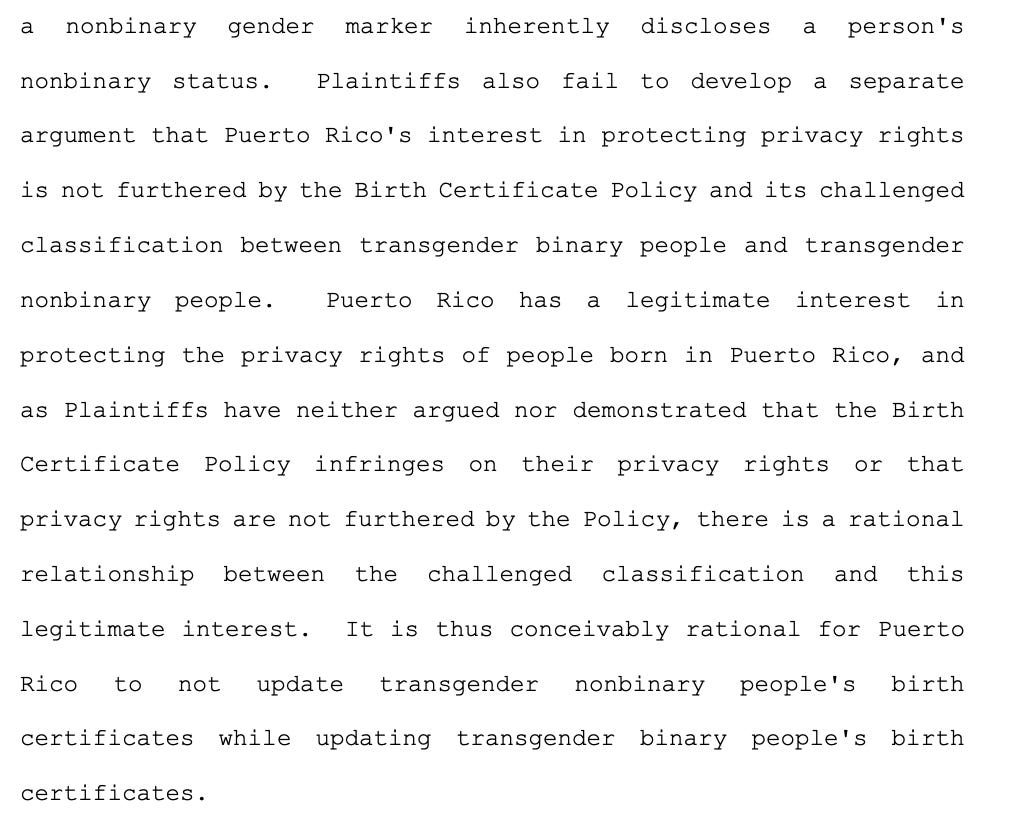
When it comes to privacy, the court essentially said the opposite, declaring that “a nonbinary gender marker inherently discloses a person’s nonbinary status,” and therefore, states are within their rights not to recognize them. In upholding that justification, the ruling implies that Puerto Rico—and by extension, other states—actually protect non-binary people’s privacy by actively erasing them.
While that part about disclosure is true, it must be noted that a non-binary gender marker does still protect a non-binary person from having to reveal their sex assigned at birth, and this is parallel to a privacy interest the district court explicitly recognized in Arroyo González. There, it specifically ordered the territory to provide trans people with birth certificates that do not indicate that they’ve been amended. Furthermore, a process for non-binary identification usually allows non-binary individuals to keep their legal name changes private as well, and that right—which is enjoyed by binary trans Puerto Ricans—has now also been denied.
Through its decision, the 1st Circuit has effectively rubber stamped any and all bans on non-binary identification documents. Although the precedent only directly applies to the areas under the 1st Circuit’s jurisdiction—Maine, Massachusetts, New Hampshire, Puerto Rico, and Rhode Island, most of which already recognize non-binary identities—as is often the case with high-profile rulings on trans people’s documents, Montecalvo’s reasoning will potentially form the basis for other restrictive court rulings around the country. And given that the 1st Circuit is the most progressive in the country and frequently rules against anti-trans policies (including Trump’s trans passport ban), it unfortunately signals that, at least for the time being, US courts will not be receptive to lawsuits over non-binary IDs.
As horrific as this ruling is, Puerto Rico’s response has been similarly concerning. Two days after the ruling was issued, the governor released a statement celebrating it as “defending the authority of the Government of Puerto Rico” to only “recognize male and female sex markers on birth certificates.” But behind the scenes, other changes were taking place. That same day, all materials relating to the gender change policy were suddenly removed from Departamento de Salud’s website, including the forms, instructions, policy documents, and a PDF showing the annual statistics for gender changes in Puerto Rico. As of the writing of this article, the only remaining reference to the policy is present in an image listing ‘Cambio de género’/‘gender change’ among the services provided by the central office. However, that image was likely developed before the ruling occurred.
It must also be noted that these resources have not been removed out of a need to update them to remove the inclusion of non-binary markers, as last year’s district court ruling was stayed before the territory was forced to comply. Web archives show that none of those materials were ever changed in the first place.
Transitics has reached out to the Demographic Registry (Registro Demográfico, RD) for an explanation through several channels but is yet to receive a response on the matter. The few RD employees Transitics did manage to speak to were equally confused about the forms’ absence, and one was even insistent the information was still present until she checked the website herself and found them missing.
Sadly, this wouldn’t be the first time a lawsuit over non-binary recognition results in a crackdown on trans people’s documents more generally. After Oklahoma’s Department of Health settled a case over non-binary markers on its birth certificates in October 2021, the state’s governor quickly responded by signing an executive order banning all gender changes in the state. The lawsuit surrounding that ban is currently ongoing.
Unless Puerto Rico’s RD is able to adequately justify the total removal of the gender change materials, the likely explanation could very well be that Puerto Rico may be looking to relitigate the 2018 ruling as well. Should that case eventually reach the Supreme Court, the outcome almost certainly wouldn’t be positive. And even if Puerto Rico isn’t looking to change its policy for binary trans people, one thing is certain: just by removing those resources from its website, the territory has deliberately made it harder for all trans people to have their identities recognized.
Although the 1st Circuit may pretend that the impact of its ruling is only limited to non-binary people, it’s clearly affecting binary trans people too. Because, at the end of the day, our fight to have our identities recognized is one and the same, and as Puerto Rico and Oklahoma—as well as Arkansas and Indiana, which previously recognized non-binary markers on driver’s licenses—have shown, the push to limit that recognition won’t just stop with non-binary people.
The American citizenry writ large is not defined by the current vile Administration. The people in PR similarly are not defined by the island’s present government.