

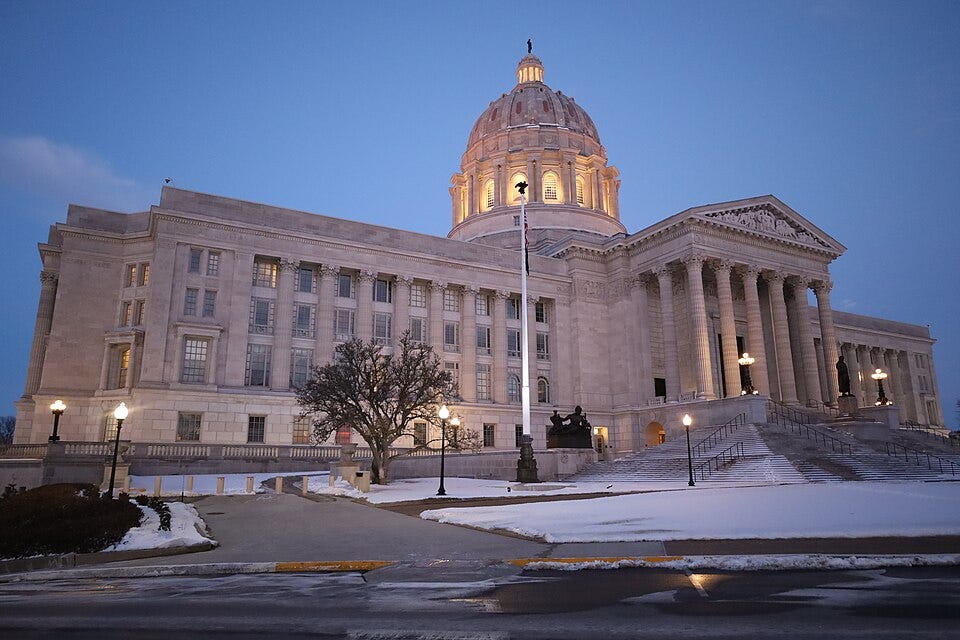

This month, Missouri Republicans have prefiled a large number of anti-trans bills for consideration during next year’s legislative session. Many of these are extreme: proposed bills would effectively ban gender-affirming care for all ages, ban trans kids ‘socially transitioning’ in schools, block trans people from updating their birth certificates, and amend the state constitution to permanently ban gender-affirming care for minors and abortion.
As part of this assault on Missouri’s trans community, state lawmakers have already filed three separate bathroom bills: HB 1893, HB 2314, and SB 1389. Of these, HB 1893 is by far the most narrow and would grant immunity to K–12 private schools that choose to implement anti-trans bathroom policies. This idea is fairly familiar: various states have passed laws that allow—but do not compel—private entities to implement bathroom bans, but these bills are usually much broader.
Last year, New Hampshire did exactly this when the Republican-controlled General Court passed HB 148, which would’ve created exceptions to the state’s explicit gender identity discrimination protections when it comes to bathrooms, sports, and prisons. However, the governor, Republican Kelly Ayotte, vetoed the bill due to its broadness. Another Republican state without formal bathroom restrictions, neighbouring Kansas, also passed a similar bill in 2023, which became law after the legislature overrode the governor’s veto.
That said, other states have passed laws that force private entities to implement bathroom bans in limited circumstances. Bathroom laws in Florida and Ohio also apply to private colleges, and several others apply to any domestic violence shelters that are at least partially state-funded. And yet, Missouri’s other bathroom bills—SB 1389 and HB 2314—take this idea much further.
First, there’s SB 1389. This bill was authored by Nick Schroer, a state senator who is considered to be one of Missouri’s most far-right Republicans, and strangely, this isn’t the first time he’s proposed it. According to SB 1389’s summary, this bill is identical to last year’s SB 632, which forces any “business entity,” whether it’s open to the public or not, to implement a bathroom ban. Under it, if a business “has a policy allowing for individuals of one biological sex into changing facilities or restrooms designated for use by the opposite biological sex,” a cis person whose ‘privacy’ was violated by a member of the opposite ‘biological sex’ will be able to sue. And it stipulates that a successful plaintiff will recover no less than $10,000.
This broadness is essentially unheard of. Even in states with trans discrimination protections, those laws are limited to places of “public accommodation,” and this is also true for laws that protect other groups. Simply put, a law like this would be extremely vulnerable to a legal challenge. Thankfully, this bill isn’t much of a threat. Last year, none of the chamber’s other 23 Republicans were willing to cosponsor it, and as such, it died in committee without a hearing.
However, HB 2314 is a completely different story. Instead of creating a new category of lawsuits, State Representative Deanna Self is proposing a different ‘solution’: weaponising the state’s existing anti-discrimination laws. Under this bill, Missouri’s current public accommodations discrimination protections, which cover “race, color, religion, national origin, sex, ancestry, or disability” at private businesses open to the public, would be amended to state that allowing “any person to use a changing room or restroom that has been designated for use exclusively by persons of the opposite sex” constitutes unlawful discrimination.
This concept isn’t new: at the federal level, the Trump administration has already begun implementing something similar. Back in July, the Department of Justice released a memo informing all federal funding recipients that allowing trans people to access bathrooms that correspond to their gender identity violates Title IX’s sex-based discrimination protections. Many colleges—including Brown, Cornell, and Northwestern—have since agreed to include this document as a faculty training resource following months of funding pressure.
But HB 2314 is even stranger. Reading it closely, something becomes apparent: people don’t need to have cause or standing to file a complaint with the Missouri Commission on Human Rights. Unlike SB 1389, there’s no qualifier stating that the violation has to have affected the complainant. In fact, the simple belief that a trans person has entered the bathroom that doesn’t align with their ‘biological sex’ at any point during the last 180 days is sufficient to file a complaint. Moreover, filing a complaint with the MCHR is entirely free.
And worst of all, as written, it doesn’t stipulate whose rights are violated when a trans person uses a bathroom. Instead, it merely defines the fact that a trans person entered the bathroom as being inherently discriminatory, which means that, hypothetically speaking, a trans person who isn’t stopped from using the correct bathroom will have had their ‘rights’ violated and can file a complaint accordingly. If this is done enough, it will severely limit Republicans’ ability to enforce the bill—regardless of how courts end up interpreting the statute down the line.
But whatever form this bill ends up taking, should it pass, it will still achieve its goal: bathroom policing. Businesses fearing lawsuits will have no choice but to actively prevent these so-called “violations” from occurring, and this will only lead to cis and trans women being subjected to scrutiny and harassment.
Currently, Missouri is part of a shrinking handful of Republican-led states that haven’t implemented at least some bathroom use restrictions, but as these bills show, not every Republican wants to maintain this status quo. Even if these bills don’t pass next year, they could still serve as a blueprint for Republicans in other states. Make no mistake: laws like this hurt everyone, not just trans people. But now that a growing number of states have bathroom bans encompassing all public buildings, the question needs to be asked: will anti-trans laws targeting private businesses be conservatives’ next goal?
Hmmm.. “A Trans Person Pee’d Here” stickers, slapped in each stall by anyone, cis or trans, as proof, a nice script to generate complaints with the Missouri Human Rights Commission, cut a deal with a hungry lawyer to split proceeds, and … PROFIT!
Yeah, this will end well.
Missouri cannot pass a bill that bans adults from receiving transgender care. That would violate numerous laws, federal court rulings, and the United States Constitution.
Missourians voted to enshrine abortion rights in the state Constitution and Missouri Republicans are going to have us vote on keeping abortion, but now they want to add a part to ban gender affirming surgery on minors even though this violates their own requirement of one item per Amendment/Proposition proposal.