

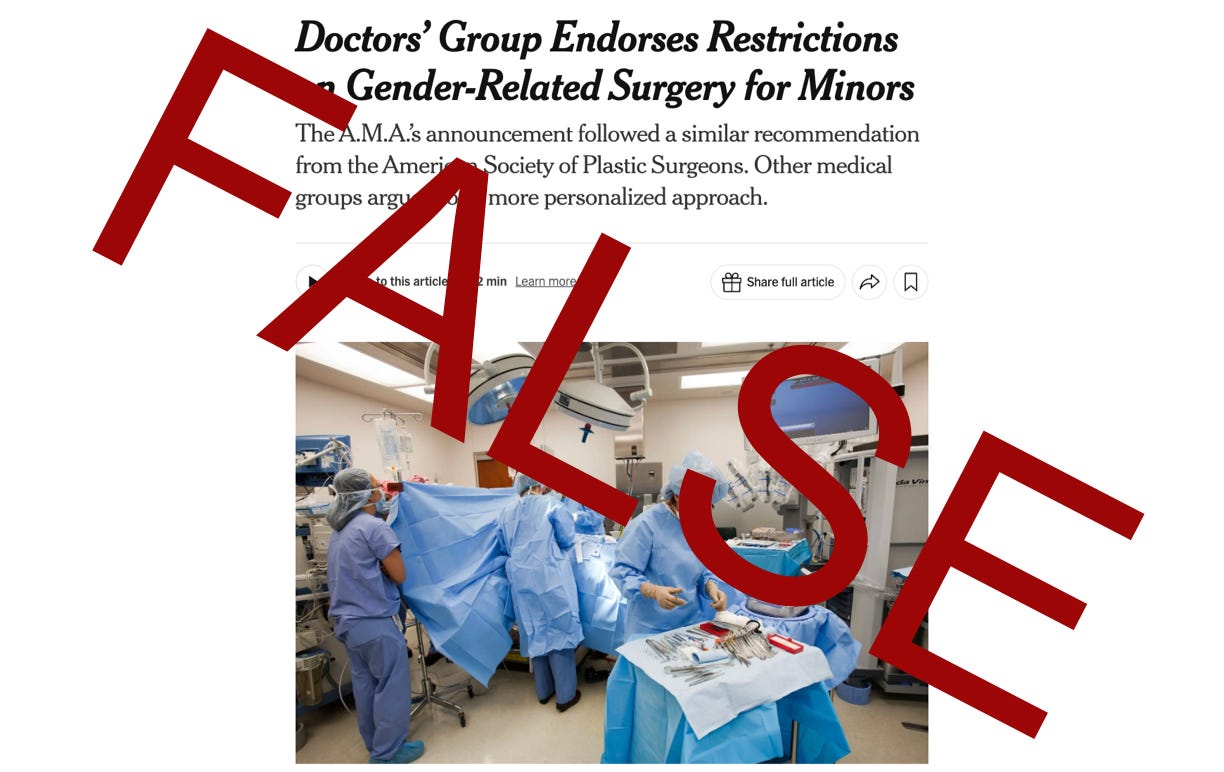
Earlier this week, on the heels of a detransitioner’s victory in a malpractice lawsuit, the American Society of Plastic Surgeons (ASPS) released a statement recommending that gender-affirming surgeries should be delayed until a patient is at least 19. Citing the UK’s Cass Review and the Trump administration’s ‘comprehensive’ report from last year, the ASPS concluded that there is “insufficient evidence demonstrating” positive outcomes when it comes to gender-affirming care for trans youth.
Almost immediately, conservatives were quick to seize on the news. Right-wing sources like the National Review and the New York Post praised the move, with RFK’s HHS hailing it as “helping protect future generations of American children from irreversible harm.”
The next day, the American Medical Association (AMA)—the largest medical organization in the US—responded to the ASPS’ new position, writing that while “the AMA supports evidence-based treatment, including gender-affirming care,” “in the absence of clear evidence, it agrees with ASPS that surgical interventions in minors should generally be deferred to adulthood.” Following this, the New York Times reported that these statements mean that both are now “endorsing restrictions on gender-related surgery for minors.”
However, this characterization is unequivocally false: no major medical organization in the United States has supported laws restricting access to any form of gender-affirming care, and even after these announcements, this has not changed. In its statement, the ASPS maintained its “opposition to criminalization of medical care,” asserting that “the regulation of medical care is best achieved through professional self-regulation, rather than criminal law or punitive legislative approaches.”
Nor does this stance bind practitioners. The document explicitly states that it is “not a clinical practice guideline” and that the organization “has not undertaken a formal guideline development process, including independent systematic evidence assessment, consensus panels, or strength-of-recommendation determinations.”
That said, something is problematic: the ASPS is taking the position that there is “insufficient evidence demonstrating a favorable risk-benefit ratio for the pathway of gender-related endocrine and surgical interventions in children and adolescents.” While the organization has virtually no authority over other forms of gender-affirming care, in considering the Cass Review and HHS Report as ‘evidence,’ it lends credibility to the right-wing idea that there isn’t a medical and scientific consensus over gender-affirming care.
Another issue stems from the fact that the ASPS has recommended surgery be withheld from those under 19 years old—not 18. This was a matter the AMA entirely avoided addressing in its statement, only making reference to the term “minors.” Although in previous years, “minors” would have been assumed to mean those under 18, this may no longer be the case. Since taking office, Trump has pushed the definition to include anyone under 19 when it comes to gender-affirming care. This marks the first time that a major medical organization has accepted this expanded rhetoric.
It’s worth mentioning that 18 is considered the age of majority by 47 states and the federal government. As such, there is no material legal difference between the federal government restricting gender-affirming care to those under 19 and the federal government restricting it for those under 21, 26, or 50. Now that the ASPS has legitimized this entirely arbitrary figure, the question needs to be asked: if Trump moves the line even further, will the ASPS follow suit?
This acquiescence may very well be political. As pointed out by civil rights attorney Alejandra Caraballo, the ASPS’ president, Bob Basu, has a history of donating to Republican candidates like Donald Trump and Ted Cruz. And considering that the position statement was issued by the organization’s board of directors without any formal or public process, it’s certainly not a stretch to say that Basu’s established ideological leanings may very well have played a role in both the existence of the document itself and the ages it impacts.
Then there’s the AMA’s response, which conservatives have similarly celebrated. However, it reflects nothing new: minors typically don’t undergo gender-affirming surgeries. Those that do are determined on a case-by-case basis, and this approach is actually supported by the assertion that “the AMA agrees with ASPS that surgical interventions in minors should generally be deferred to adulthood.”
Here, the word ‘generally’ serves as an important qualifier: contrary to the position the ASPS is taking, gender-affirming surgeries for those under 18 aren’t prohibited as a rule—nor does the AMA oppose them if a practitioner deems them necessary. Furthermore, as mentioned earlier, the organization also pushed back against the ASPS’ idea that other forms of gender-affirming care are not backed by evidence. It’s also worth noting that, unlike the ASPS, the AMA has the expertise necessary to speak credibly on this issue.
That said, none of this will stop those who are anti-trans from pretending that these statements constitute an endorsement of gender-affirming care bans. But even then, this may not have much of an impact. For years, conservatives have leaned on groups like the Society for Evidence-based Gender Medicine (SEGM) and Genspect, and within anti-trans discourse, the ‘findings’ of these organizations are treated as having the same weight as studies published by the Endocrine Society and AMA—if not more.
Because to the right, the source of these claims truly does not matter. Those who encourage restrictions on gender-affirming care will always find reasons to keep doing so, even if it’s just an anecdote from someone like Chloe Cole. And legislators in red states will view that evidence as legitimate regardless of its credibility. Last June, the Supreme Court legitimized this exact idea, holding that, when it comes to gender-affirming care for minors, there are “open questions that exist regarding basic factual issues before medical authorities and regulatory bodies.” This is despite the fact that there is a universal opposition to these laws among major medical organizations.
The largest consequences will fall on trans youth. Over the last few years, and especially in the past 12 months, their care has gotten significantly harder to access. Prior to making these statements, the AMA and ASPS should’ve taken a moment to consider the effects they may have on trans minors, as it’s possible that practitioners may feel uneasy about providing this care moving forward. These organizations have a responsibility to put patients above politics.
The media has similarly failed trans kids. This week’s news is not an endorsement of gender-affirming care bans, nor is it an excuse to support them. One non-binding position statement and a response reiterating a commonly accepted position are not nearly sufficient evidence to overturn decades of research—touting it as such is entirely a political decision. For trans youth, it’s unacceptably dangerous. Simply put, the AMA, ASPS, and New York Times must do better.
""the organization has not undertaken a formal guideline development process, including independent systematic evidence assessment, consensus panels, or strength-of-recommendation determinations.”"
So in summary, ASPS is talking out of it's ass for political points with the Trump administration.