

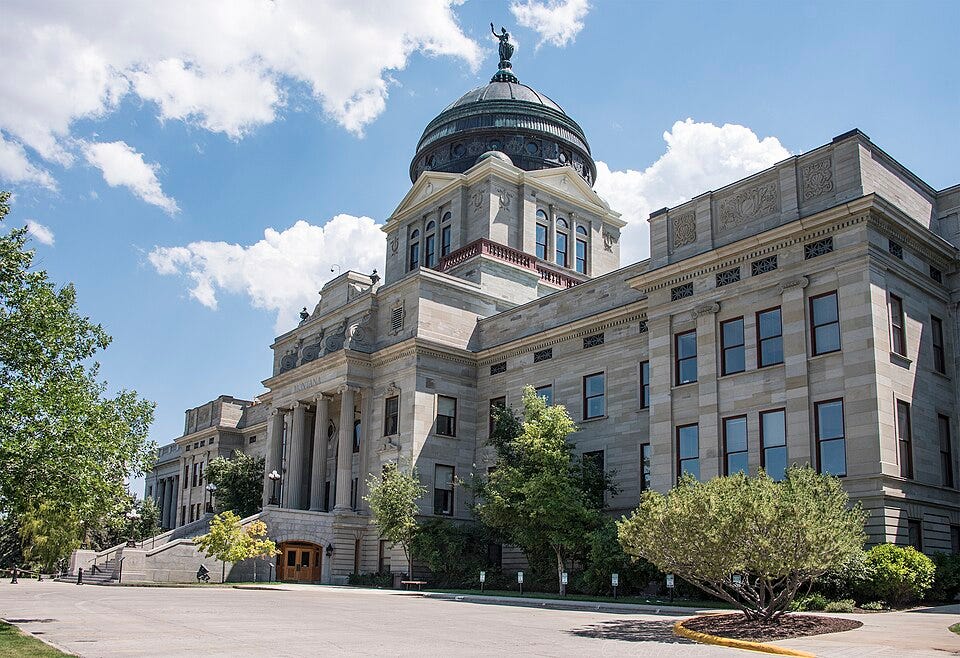

On Tuesday, the Montana Supreme Court released its decision in Kalarchik v. State of Montana, a case concerning trans people’s birth certificates and driver’s licenses. In a 5-2 ruling, the court’s liberal majority upheld an injunction blocking the state’s restrictive gender marker policies, which were quietly implemented between 2022 and 2024.
On the surface, the ruling doesn’t appear to be that significant; after all, the Montana Supreme Court has a history of ruling against anti-trans laws—most notably its gender-affirming care ban in 2024. However, in that case, the court declined to address the plaintiffs’ argument that the law was discriminatory and instead based its ruling on the right to privacy, which, unlike at the federal level, is explicitly guaranteed by the Montana Constitution. But writing a concurring opinion, Justice Laurie McKinnon urged the court to adopt the US Supreme Court’s Bostock reasoning and rule that discrimination based on gender identity constitutes sex discrimination.
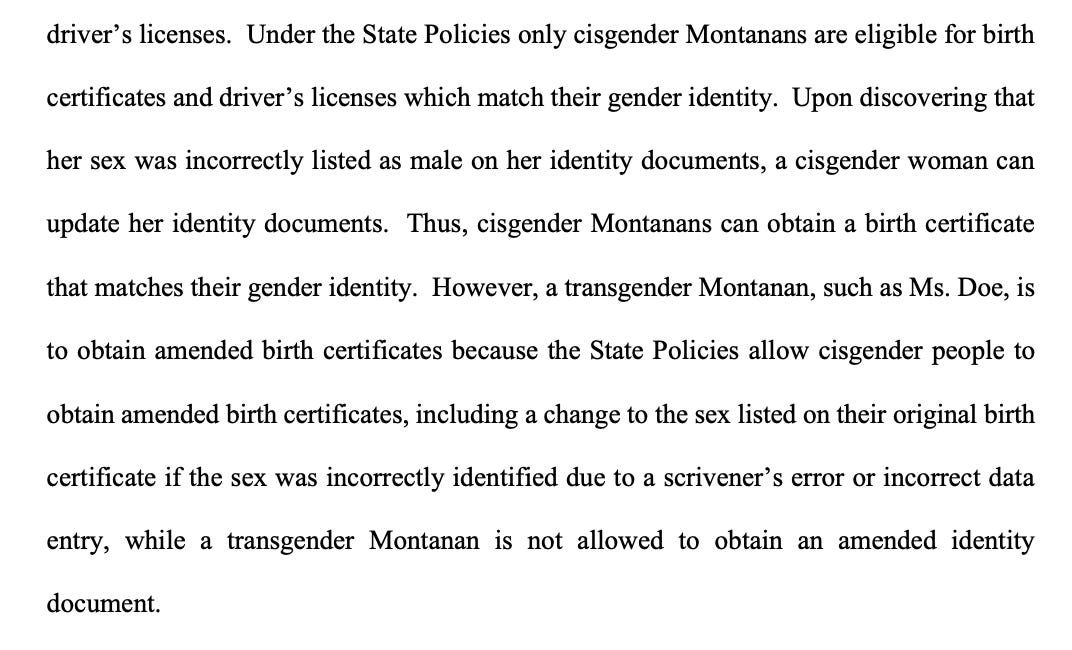
One and a half years later, the court’s majority has now sided with McKinnon, holding that “when [a person’s documents] do not accurately reflect a person’s sexual identity, the transgender Montanan is prevented, based on their sex, from obtaining the same attributes of public life that a cisgender Montanan may obtain.” Her reasoning is fairly simple:
“Upon discovering that her sex was incorrectly listed as male on her identity documents, a cisgender woman can update her identity documents. Thus, cisgender Montanans can obtain a birth certificate that matches their gender identity. However, a transgender Montanan, such as Ms. Doe [one of the plaintiffs], is not allowed to have birth certificates and identity documents which match her gender identity. Thus, transgender and cisgender Montanans are treated unequally in their ability to obtain amended birth certificates.”
Applying this concept more generally, McKinnon wrote:
“Transgender discrimination is, by its very nature, sex discrimination. Discrimination based on sex is expressly prohibited under Montana’s unique Nondiscrimination Clause––’[n]either the state nor any person, firm, corporation, or institution shall discriminate on account of…sex…’ Thus, Article II, Section 4 is unequivocal in its intolerance for discrimination based on sex.”
As a result of this fact, the court declares that strict scrutiny—the highest level of judicial review—must be applied to discrimination based on transgender status.
On top of this, McKinnon also rebuked the state for misgendering the plaintiffs, calling out the fact that the evolutionary behavioral ecologist it hired to defend the law, Colin Wright, “uses the singular they/them pronouns to refer to Ms. Kalarchik and Ms. Doe throughout his declaration despite his insistence that both plaintiffs are biological males.”
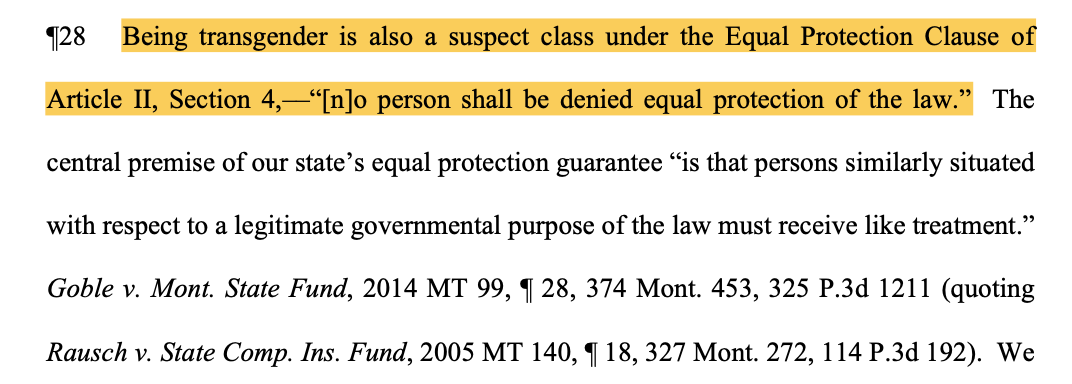
And the court went even further. On page 18 of the ruling, the majority declares that “being transgender is also a suspect class under the Equal Protection Clause of Article II, Section 4,—‘no person shall be denied equal protection of the law.’” For some context, in discrimination law, a suspect class is generally defined as being a minority with a shared trait that has been historically discriminated against. Under precedent, laws that impose classifications based on suspect class status face strict scrutiny. Conversely, laws that discriminate against quasi-suspect classes face intermediate scrutiny, while laws that do neither are evaluated under rational basis review.
At the federal level, there are only 4 suspect classes—race, religion, immigration status, and national origin—and 2 quasi-suspect classes—sex and legitimacy of birth. Notably, up until this point, no state supreme court had ever declared trans people to be a suspect or quasi-suspect class. In fact, in the US Supreme Court’s Skrmetti decision, Amy Coney Barrett wrote a concurring opinion explicitly rejecting the notion. There, Barrett argued that “transgender status is not marked by the same sort of ‘obvious, immutable, or distinguishing characteristics’” because “the category of transgender individuals is ‘large, diverse, and amorphous.’”
Montana Supreme Court Chief Justice Cory Swanson explicitly cited Barrett’s reasoning in his dissent, writing that “the Court’s vague description of transgender status incorporates something entirely subjective and fluid, turning on a person’s internal gender identification.” Moreover, he asserted that “once a subjective, fluid self-identity becomes a basis for a suspect class, there is no logical stopping point to equally recognizing any number of other suspect classes defined by one’s subjective motivations.”
And there’s a reason Barrett and Swanson are so reluctant, which Barrett herself explained rather succinctly: “holding that transgender people constitute a suspect class would require courts to oversee all manner of policy choices normally committed to legislative discretion.”
Here, it’s no different. This ruling effectively delivers a death sentence to all of Montana’s anti-trans laws, including its bathroom ban, sex definitions law, drag ban, forced outing law, Medicaid policy, and sports ban as well as any anti-trans laws passed in the future. It means that moving forward, whenever an anti-trans policy is challenged, courts will consider it to be presumably unconstitutional until proven otherwise. And without a change in the court’s composition, the Montana Legislature likely won’t be able to circumvent this ruling.
Simply put, this is an unprecedented victory. With federal courts more hostile than ever to trans people’s legal challenges, the Montana Supreme Court took it upon itself to stop the GOP’s assault on trans Montanans dead in its tracks. It ensures that, for trans people, Montana will remain among the least hostile red states for years to come. And in a year that has seen Republicans across the country launch unparalleled attacks on the trans community, it serves as a reminder that not all hope is lost.
Finally some decent news for us, instead of all the crazy sounds coming from politicians. Thank you for reporting.
This is very encouraging news! Very welcome!