



On Tuesday, the Oklahoma Supreme Court released its ruling on the legality of gender marker changes in the state, where it found that trans Oklahomans have never had the right to change their birth certificates. The relatively short 6-3 decision—which was requested by the federal 10th Circuit Court of Appeals as part of the ongoing trans birth certificate case Fowler v. Stitt—upholds the state’s anti-trans policy and further complicates trans Oklahomans’ path to obtain accurate documents.
Of course, it wasn’t always that way. In 2007, the Oklahoma State Department of Health (ODH), then under the state’s last Democratic governor, Brad Henry, started allowing trans people to update their birth certificates if they were able to obtain a court order confirming their identities. Even as the state’s Supreme Court acknowledged last week, the policy “was largely non-adversarial and persisted with little notoriety,” and as per Transitics’ prior research, it brought Oklahoma in line with the other 44 states that allowed these changes. As early as 2018, the ODH included instructions for legal gender changes on its website, where it stressed that it “does not require a physician’s statement.” Although the website was redesigned after the current governor, Kevin Stitt, took office in 2019, those instructions remained on the page well past that point.
In fact, it wasn’t until 2021 that the policy attracted any controversy. That October, the ODH announced a settlement with an Oklahoma-born non-binary Oregon resident—who had obtained a court order in Oregon for a non-binary marker—and was seeking to have their identity recognized. Under the terms of the agreement, the state would allow ‘X’ designations on birth certificates using the same court order process; in doing so, it made Oklahoma the first southern state to implement such a policy.
However, this victory was ultimately short-lived. After significant backlash from the state’s Republican supermajority, Stitt issued Executive Order 2021-24, which prohibited the ODH from recognizing trans people’s identities. The resulting lawsuit, Fowler v. Stitt, quickly moved to challenge the policy, but after securing a favorable ruling from the 10th Circuit in 2024, the Supreme Court vacated the order the following year and remanded the case back to the 10th Circuit. In the interim, the state’s Republican legislature quickly moved to codify Stitt’s ban, passing a law banning the state from recognizing non-binary markers in 2022. Earlier this year, the state passed a separate law explicitly requiring birth certificates to contain a person’s ‘biological sex.’
Because of those developments, the 10th Circuit asked the Oklahoma Supreme Court to answer three related questions about the state’s birth certificate laws:
Whether Oklahoma law currently permits “changes to the sex designation on an Oklahoma birth certificate.”
Whether Oklahoma law has “ever permitted changes to the sex designation on an Oklahoma birth certificate.”
Whether Oklahoma law “does now or has ever permitted changes to the sex designation on an Oklahoma birth certificate based on gender identity.”
On Tuesday, the court reached its verdict, and unsurprisingly, it simply answered ‘no’ for all three questions. But unlike other courts that have issued similar rulings in trans birth certificate cases, the Oklahoma Supreme Court went much further, asserting that sex markers cannot be changed under any circumstances.
At the center of its decision is the provision of state law regarding amendments to birth certificates, 63 O.S. § 1-321—which was first adopted in 1963—and its accompanying regulation, OK Admin Code 310:105-3-3—which was last amended in 2007. According to the court, the stipulation in 63 O.S. § 1-321 that birth certificates ‘may be amended only in accordance with this article and regulations thereunder’ “conveys exclusion and limitation,” and as such, “amendments to birth certificates are limited to those explicitly listed under article 3 or the regulations promulgated by the State Commissioner of Health in Title 310:105-3-3 of the Oklahoma Administrative Code.”
That regulation further allows for names to be added or changed when incorrectly recorded and for “other changes” to be ordered by an “Administrative Law Judge.” If the regulation conflicts with the law, however, “the agency has no discretion to act outside the agency’s statutory powers,” the court wrote. Where it gets more interesting, however, is that between 1978 and 2007, OK Admin Code 310:105-3-3 (and its precursor) actually used to be much broader. Under that version, virtually all amendments were allowed at the discretion of the ODH.
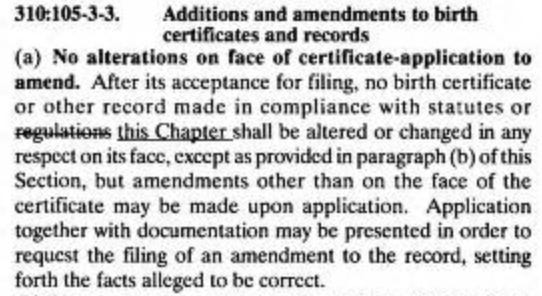
In the absence of a permissive provision, the court interpreted the regulation in a more restrictive way. In its words, “neither 63 O.S. §1-321 nor Okla. Admin. Code § 310:105-3-3 provides for changing a sex designation” in any explicit sense, and thus, those changes are not allowed—and have never been legally allowed—under any circumstances, even when a clerical error was made on a cis person’s certificate. Because the questions regarding “changes to the sex designation” and “changes to the sex designation…based on gender identity” were addressed separately by the court, there is little room left for ambiguity.
The ruling applies to and burdens cis, trans, and intersex Oklahomans equally.
Coupled with the fact that under the new laws passed by the legislature, this means that a person’s birth certificate will reflect their “biological sex…as identified at the time of birth,” whether or not it was correctly identified at the time of birth. In other words, all Oklahoma gender markers have been effectively ‘locked’ in place until either the law changes or the 10th Circuit strikes down the ban.
And this ‘locking’ isn’t new. Earlier this year, the state abruptly repealed its longstanding regulations allowing for gender changes on driver’s licenses. According to information obtained by Transitics, Service Oklahoma lost the authority to change gender markers altogether as a result of that repeal and can now only do so if there was a “typo or data entry error” (this presumably only applies to issuances from March onwards) on their end. Even then, those requests “require approval from a Regional Manager or Lead.” Most notably, this loss of authority also means that updated gender markers will not be reverted, either.
At the end of the day, Oklahoma shows that restrictions on trans people’s access to accurate IDs don’t just stop with trans people. As conservatives work to strip the ability for gender markers to changed in any circumstances, cis people will be caught in the crossfire, and like us, some of them will also be forced to carry inaccurate documents, impacting the opportunities they have and the way they’re treated by society.
Above all, this situation raises an important question: if society agrees that cis people do not deserve to have their lives affected by an incorrect gender marker—because it emphatically does—then in what world would trans people ever deserve that?
Gender Assigned At Birth - The government assigns you a gender. This from the folks panicking about the government asking you to wear a mask.
This is getting ridiculous.