

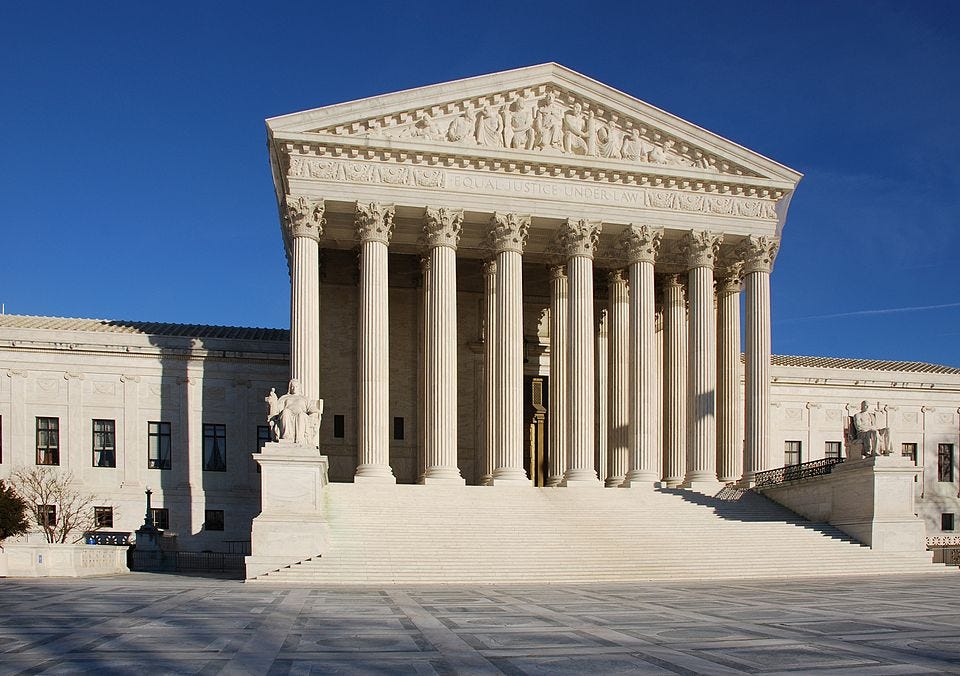

This morning, the Supreme Court released its decision in West Virginia v. B.P.J. and Little v. Hecox and, in a widely expected 6-3 ruling, upheld trans sports laws nationwide. This decision, the latest legal blow to transgender rights, comes only a few months after the court’s 8-1 ruling striking down conversion therapy bans and a year after the court’s 6-3 ruling upholding youth gender-affirming care bans. In doing so, the court has signaled to right-wing groups that the manufactured culture war against trans Americans—which started with sports participation—has largely succeeded in achieving many of the legal changes they’ve pushed for.
But notably, the 29-page majority opinion, authored by Justice Brett Kavanaugh, stipulates that its holding is not absolute, writing that “these cases do not present the distinct question of whether, under Title IX and the Equal Protection Clause, schools may allow biological males who identify as female to participate on girls’ and women’s sports teams.” Instead, the decision, like the one in Skrmetti v. United States (2025), only decides whether or not schools may “determine eligibility for women’s and girls’ sports based on biological sex.” And because the ACLU challenged the laws on both Title IX—which governs discrimination in federally funded education programs—and 14th Amendment Equal Protection grounds, the court addressed each claim separately, starting with the Title IX challenge.
In page 10, Kavanaugh unequivocally refutes the first claim, stating that “the term ‘sex’ in the 1972 Title IX statute, the 1974 Javits Amendment [the specific provision governing sports], and the 1975 Title IX regulations cannot plausibly be interpreted to refer to anything other than biological sex.” Continuing, Kavanaugh writes that “the ordinary meaning of the term “sex” at the time of enactment in the early 1970s was biological sex and not gender identity, particularly in the sports context.” Although this interpretation may seem new, it is nearly identical to the one advanced by fellow Trump appointee Neil Gorsuch in Bostock v. Clayton County (2020)—which extended employment discrimination protections to transgender Americans. There, Gorsuch, setting up the argument that gender identity discrimination necessitates sex discrimination, wrote:
“The only statutorily protected characteristic at issue in today’s cases is ‘sex’—and that is also the primary term in Title VII whose meaning the parties dispute. Appealing to roughly contemporaneous dictionaries, the employers say that, as used here, the term ‘sex’ in 1964 referred to ‘status as either male or female [as] determined by reproductive biology’… Because the employees concede the point for argument’s sake, we proceed on the assumption that ‘sex’ signified what the employers suggest, referring only to biological distinctions between male and female.”
And in his concurrence today, Gorsuch echoed this reasoning while justifying his rejection of the plaintiffs’ Title IX claim, stating that “the Court understands the term ‘sex’ in Title IX to mean biological sex, just as we understood that term in Title VII in Bostock.” To that end, he writes that “Title IX anticipates and approves single-sex living accommodations and sports teams in school settings; it does not treat them as unlawful discrimination.” As such, because some sex discrimination is allowed under Title IX, and because ‘sex’ is construed to mean ‘biological sex,’ restricting school and collegiate sports on the basis of biological sex does not violate Title IX.
It’s worth noting that B.P.J. did not contest the majority’s interpretation of ‘sex’ in Title IX as ‘biological.’ Similarly, the 3 liberal justices—Sonia Sotomayor, Ketanji Brown Jackson, and Elena Kagan—joined the majority in rejecting the Title IX claim using Gorsuch’s reasoning, though they stressed that “there are plenty of contexts outside of athletics in which Title IX applies and does not allow sex distinctions like this one to be drawn.”
Meanwhile, rejecting the Equal Protection argument, Kavanaugh endorses the arguments put forward by West Virginia and Idaho, who defended their laws by stating that their laws “help prevent serious physical injuries to female athletes and preserve opportunities for female athletes to fairly compete and succeed.” On the first point, Kavanaugh writes:
“The safety risks are at their apex in contact sports, such as soccer, basketball, field hockey, lacrosse, and ice hockey, among others. And safety concerns also exist in ostensibly non-contact sports, such as volleyball, where spiked balls can cause serious injuries, and softball, where line drives can similarly cause significant harm.”
Although this argument is nothing new, his mention of volleyball is of some interest, as it appears to be a direct nod to Payton McNabb, who became prominent for her anti-trans advocacy after being injured by a spiked ball. But Kavanaugh’s rhetoric escalates in the next paragraph:
“Sports are generally zero sum. Every biological male who makes the team takes a roster spot from a female athlete. Every biological male who earns playing time reduces the playing time of a female athlete. Every biological male who starts takes a starting position from a female athlete. Every biological male who wins a race takes the gold medal away from a female athlete. And so on. Even if only one or a few males were to play on a women’s or girls’ team, that would still place specific individual female athletes at a significant competitive disadvantage.”
This, of course, largely echoes conservatives’ main attack against trans athletes, which contends that trans women who are allowed to participate in women’s categories are ‘stealing’ medals and opportunities from cis women. Agreeing with both arguments, Kavanaugh writes that a sex-based classification “is substantially related to those interests” and, as such, allows the laws to overcome intermediate scrutiny.
Moreover, addressing B.P.J.’s narrower claim, he writes that “States are not required to conduct an individual-by-individual comparison of the physical and athletic capabilities of all biological males in order to satisfy intermediate scrutiny.” Rather, “intermediate scrutiny permits a sex-based classification that, as here, is “not invidious, but rather realistically reflects the fact that the sexes are not similarly situated in certain circumstances.”
But while there are many things this ruling impacts, there are also many things it doesn’t. Firstly, as stated earlier, it does not require that states or schools adopt policies banning trans athletes. Nor does it establish that allowing trans athletes to compete in women’s categories explicitly violates Title IX. Instead, like Skrmetti, it defers that matter entirely, writing that “the legislatures and the schools are better equipped—and under the Constitution, are the more appropriate entities—to assess the competing medical and scientific considerations and draw appropriate lines.”
As such, today’s decision, coupled with the fact that Title IX does not expressly mandate strict sex separation in sports, potentially undermines the Trump administration’s threats against schools and universities over trans sports participation. If true, that would be a massive victory: over the past year and half, Trump has weaponized federal funding through the lens of Title IX enforcement—in fact, his executive order on trans women in sports itself entirely relies on his administration’s restrictive interpretation of Title IX. Furthermore, the Department of Justice has similarly attempted to argue that “failing to maintain sex-separated intimate spaces [defined as ‘bathrooms, showers, locker rooms, or dormitories’] can also violate federal law” as it “can violate Title IX by denying women access to the full scope of sex-based protections in education.”
By emphasizing that the authority to regulate this issue lies with the states and schools, the Supreme Court complicates the federal government’s assertion that Title IX itself imposes a uniform and restrictive rule; whether or not that argument is advanced in court will be up to the few institutions willing to challenge the funding restrictions. It’s also worth mentioning that Title IX does not explicitly require that educational institutions maintain sex-segregated sports teams or bathrooms. That said, his administration likely won’t interpret the ruling in that fashion. If anything, the federal government will only use this ruling to double down on its aggressive enforcement of Title IX as it did following Skrmetti.
Some institutions may comply in advance. Lawsuits may attempt to incorporate the ruling into arguments that hinge on the court’s restrictive interpretation of Title IX. And it won’t undo the damage that has already been done: the NCAA will continue to entirely bar the handful of trans athletes from collegiate sports; California will continue to essentially nullify the accomplishments of trans athletes like AB Hernandez; and despite Kavanaugh’s urging that “no student-athlete on either side of the issue, whether a biological female or transgender, deserves to be ostracized or vilified,” trans kids who want to play sports with their friends will continue to face harassment from anti-trans voices in their communities and online. Thanks to today’s ruling, that harassment will only get worse.
its transmisogyny
You cant discriminate against anyone it’s pretty straightforward in the Constitution and in Civil Rights.