

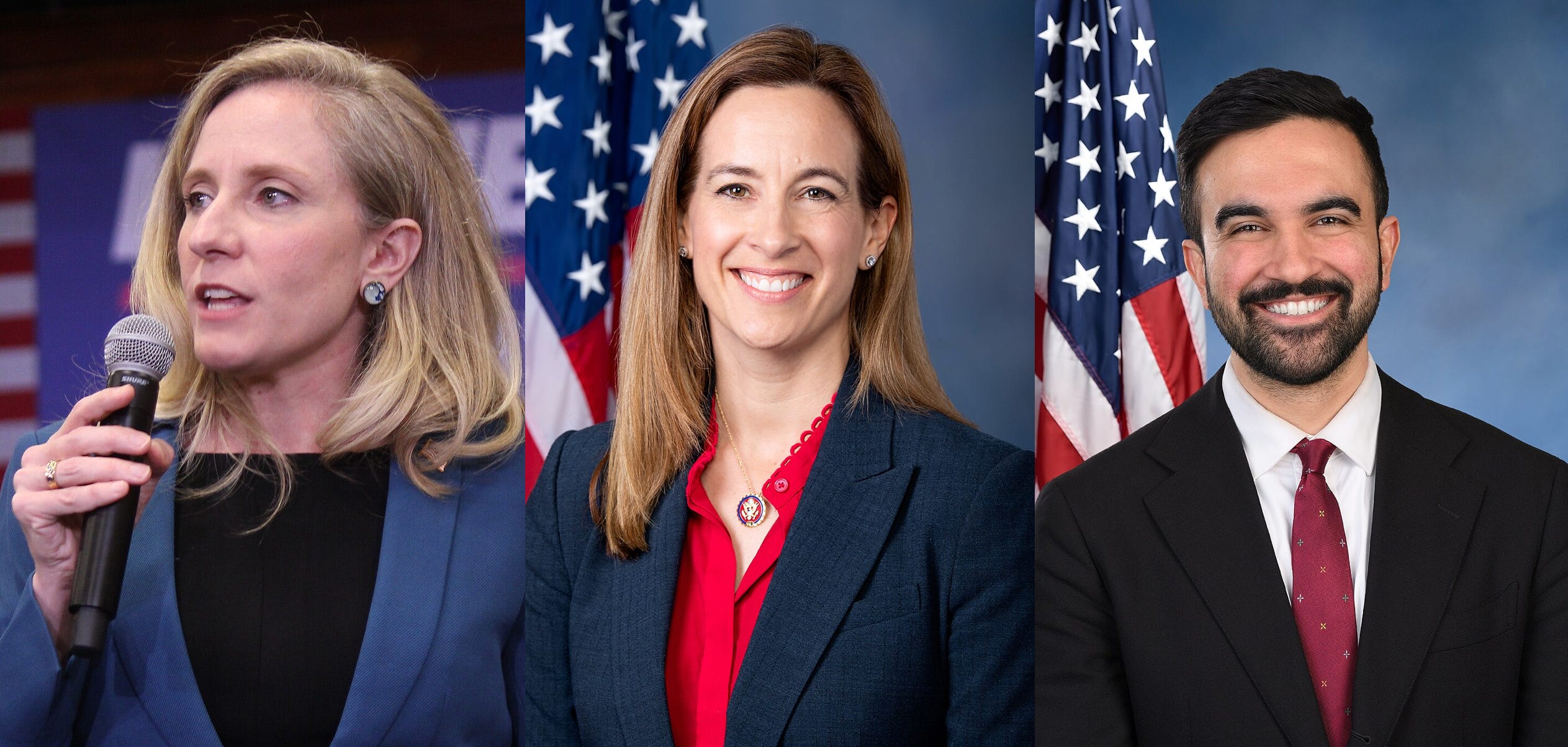
Today, voters across the country cast their ballots in the first major elections since Trump took office. Facing Trump’s historically low approval ratings, many Republicans, especially Virginia gubernatorial candidate and incumbent Lt. Gov. Winsome Earle-Sears, pivoted heavily towards anti-trans messaging in an attempt to win over voters.
But this time, the transphobia Republicans and a few centrist Democrats have claimed won Trump the 2024 election didn’t work. If anything, it may have actually cost them: in Virginia, Abigail Spanberger won with the largest margin for a Democratic governor in the state since 1961, and in New Jersey, the Republican nominee for governor, Jack Ciattarelli—who also ran in 2021—fared 10 points worse than he did 4 years ago.
This shouldn’t come as much of a surprise. The last time Virginia and New Jersey voted for governor, Republicans hadn’t decided to go all-in on anti-trans messaging, which only began to rise because GOP strategists believed it to be a good wedge issue. In fact, before Biden’s victory in 2020, only three states had any active anti-trans laws: Idaho had passed the first trans sports ban along with a ban on birth certificate gender marker changes earlier that year, North Carolina’s infamous HB 2 was partially effective but fully repealed about a month after the election, and Tennessee’s ban on trans birth certificate changes dates back to 1977.
However, after the election, things changed quickly: in 2021, Arkansas became the first state to pass a gender-affirming care ban, Montana and Oklahoma began banning birth certificate changes, and Arkansas and West Virginia passed sports bills. Sensing an opportunity, Virginia Republican Glenn Youngkin began leaning in on transphobia by framing it as a “parental rights” issue in schools, rhetoric echoed by Ciattarelli in New Jersey.
But crucially, that anti-trans messaging wasn’t alone. In both cases, it was framed as part of a larger culture war along with critical race theory, book bans, and abortion. And although it may have helped them then, the American political landscape has changed significantly since then: critical race theory fizzled out, widespread book bans largely failed to materialise, and Roe v. Wade was overturned in 2022. Of that initial culture war playbook, only trans people remain, and it’s becoming increasingly clear that this issue cannot bear the load of hate that was originally shared between the four of those.
Because of that, voters are able to recognise that hate for what it is, and it shows. A poll taken in both states just before the election found voters strongly opposed the Republican candidates’ approach to transgender rights. This is despite the fact that, according to exit polls, 50% of Virginia voters believe societal acceptance of trans people has gone “too far.” Yet, 23% of those who answered “too far,” being a little over 11% of the total electorate, still voted for Spanberger despite Earle-Sears’ focus on the issue.
In New Jersey, the percentage of those who answered ‘too far’ dropped to 45%, and similar to Virginia, 17% of that group voted for the Democrat, Mikie Sherrill. It could be that a large chunk of those swayed by anti-trans rhetoric do not consider it an important issue. Or maybe it’s that Republicans are going too far in attempting to curtail the rights of trans people. Either way, it’s becoming increasingly apparent that campaigning heavily on ‘trans issues’ is not a winning strategy despite the fact that it’s one of the few places where Republicans may have public opinion on their side.
It’s important to remember that using trans people as a political issue is a distraction. When used against a relatively unpopular administration like Biden’s, distractions like it can work on some voters. But now that Trump is in charge, that no longer applies. Even if voters were against trans people in the way Republicans want them to be, the GOP would still bear the blame for rising costs, unpopular tariffs, ICE’s horrific actions, the declining healthcare system, abortion restrictions, all the Trump administration’s relentless controversies, and so much more.
Also in Virginia, Democrats have flipped a number of state House seats, and elsewhere in the country, the opposition to Trump is just as strong. In Pennsylvania, voters retained 3 Democrats on the state’s supreme court, all but ensuring the state’s gender identity and sexual orientation discrimination protections will survive the ongoing right-wing legal challenge. In California, despite pushback from figures like former governor Arnold Schwarzenegger and ex-Speaker of the House Kevin McCarthy, Proposition 50—which aims to counteract Texas’ gerrymandering scheme—has been approved by a substantial majority.
And in New York City’s hotly contested mayoral race, vocally pro-trans Democrat Zohran Mamdani beat out former New York governor Andrew Cuomo and Republican Curtis Sliwa by around a 9-point margin amid fierce national Republican—and some Democratic—resistance. Meanwhile, Texas voters approved a new constitutional amendment to enshrine “parental rights.” It remains to be seen whether or not this will have any impact on the gender-affirming care ban Texas has had on the books since 2023.
At the end of the day, as Republicans get more unpopular, the things they stand for are dragged down with them. By leaning in so strongly on transphobia, they may very well be accelerating that fall. Because as these elections show tonight, the consensus is clear among most Americans: our nation has many problems. Trans people living freely is simply just not one of them.
Snarky Baby Marky re-imagined as if Howard Cosell were behind the microphone in a late-1970s television editorial — clipped cadence, rolling gravitas, and just enough ego to make it fun.
“Step One — The Transgender Smokescreen Before Roe Fell”
(Delivered in the Voice of Howard Cosell)
> “Ladies and gentlemen… let us be honest with one another.”
What we are witnessing… in the grand arena of American politics… is not a debate about health care. No. It is a contest for control. The so-called ‘transgender health-care crisis’—a phrase designed to inflame, not to inform—is nothing more than the opening play in a larger game.
The Affordable Care Act… that much-maligned piece of legislation… never promised anyone free surgery, free hormones, or a government-issued makeover. It said, simply and profoundly: you may not discriminate on the basis of sex. A modest declaration of fairness.
But fairness… ladies and gentlemen… does not fill campaign coffers. And so, into the breach stepped Senators Cruz and Lee—self-anointed defenders of morality—waving their banners and crying, ‘Obama’s transgender mandate!’ They took a footnote of civil rights and turned it into a full-blown moral panic.
Why? Because outrage is profitable. Because fear, in modern America, sells better than beer at a ballpark.
And make no mistake… that panic was Step One. The test run. Could the public be made to surrender autonomy in the name of righteousness? When the answer came back yes, the next target was ready: Roe v. Wade. The same language, the same slogans—“protect life,” while quietly erasing the right to live one’s own.
The Founders, I remind you, understood what it meant to have one’s body owned by another. They lived among slavery. So when they wrote of life, liberty, and the pursuit of happiness, they were not indulging in poetry; they were declaring that no man, no church, no government may hold another hostage.
Yet here we stand—two centuries later—watching politicians in the costume of patriots attempt to rewrite that promise. To dictate identity, to legislate obedience, to decide, once again, who owns the body and the will of the citizen.
This… is not freedom.
So, ladies and gentlemen, remember the simple truth: the right to life means the right to your life body mind and soul. Not life on somebody else’s leash.
And that… is Howard Cos
ell… speaking of America.