

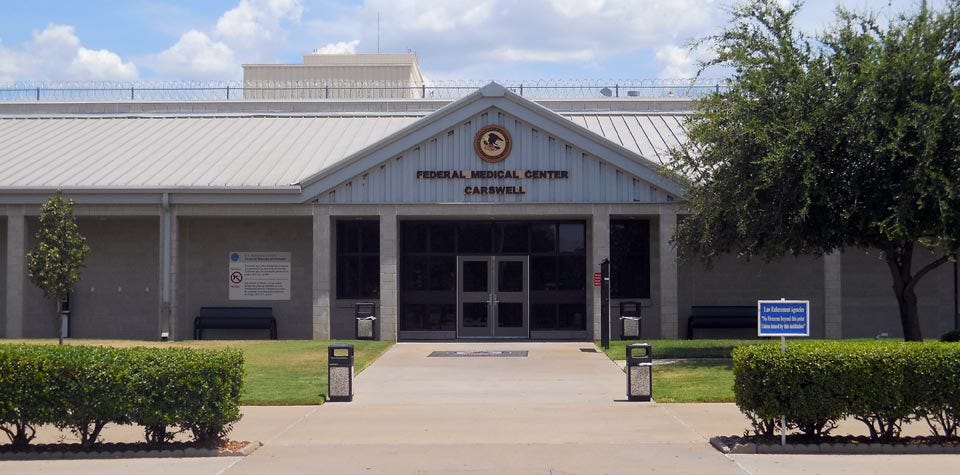
In February, the Trump administration released its policy concerning the treatment of trans people in federal prisons. As Transitics reported at the time, the policy is horrific: under it, the ~2,200 trans people in federal custody will be medically and socially detransitioned against their will, all in the name of helping them “recover” from gender dysphoria.
And over the next few weeks, more details emerged: when making the policy, the federal Bureau of Prisons (BOP) admitted to being aware of and simultaneously disregarding existing medical standards while forcing arbitrary guidelines—developed from research entirely unrelated to gender-affirming care—onto a captive population. It also implied that it expected suicide attempts to increase as a result of its actions. In an effort to justify these egregious actions, the BOP has since tried arguing that withholding gender-affirming care is necessary to protect trans people from harm.
Given these facts, Transitics has previously characterized these policies as medical experimentation—and courts have so far agreed. The judge overseeing the ACLU’s challenge, Reagan appointee Royce Lamberth, has granted several injunctions against the policy, leaving its future up in the air. But unfortunately, this isn’t the only way the Trump administration is trying to abuse trans prisoners.
As part of the same January 2025 executive order that stripped trans prisoners’ access to healthcare, the BOP was ordered to “ensure that males are not detained in women’s prisons.” Within days, the handful of trans women housed in women’s prisons were informed that they would soon be transferred to men’s prisons, where they’d face alarmingly high rates of physical abuse and sexual violence. They quickly sued, and Lamberth, also in charge of their case, has so far issued seven injunctions preventing the Trump administration from housing them with men.
However, despite these losses, the BOP remains determined to make these women suffer as much as possible. And on June 2nd, it was given the excuse it needed.
That day, a North Texas judge granted a preliminary injunction in the case Fleming v. Warden T. Rule, where a group of cis women in federal women’s prison FMC Carswell are challenging the fact that four trans women are housed in their facility. This ruling—technically a ruling against the BOP—ordered the prison to use “separate movement, routing, scheduling, or other measures as necessary to prevent overlap between male inmates [defined as ‘any inmate who is biologically male, regardless of gender identity’] and female inmates in housing and shared spaces.”
Because the four trans women in question are plaintiffs in the case against Trump’s trans housing policy, Lamberth amended his injunction to stipulate that the Fleming ruling didn’t give the BOP grounds to transfer them to a men’s prison. To comply with both injunctions, the FMC Carswell created a separate unit to house its trans population.
To be clear, this alone wouldn’t be problematic: in 2024, Colorado created two prison units entirely for trans women after being sued by trans women who faced years of mistreatment and abuse. And while the solution isn’t perfect, it’s garnered significant praise from advocates for being a major step towards making prisons safer for trans women and could potentially be replicated elsewhere without much controversy.
Needless to say, a unit for trans women shouldn’t be used to make them suffer. And yet, that’s exactly what the BOP is using it for. Here’s how one of the plaintiffs, known by the pseudonym Emily Doe, described the unit’s conditions in a July court filing:
“All of us are transgender. We are housed…with two women in each cell. We are not allowed to leave the unit unless we are escorted and surrounded by corrections officers. Because of the staffing required to move us, the officers never want to bring us anywhere. Meals are delivered to the unit and we must eat in the unit, or sometimes in our cells. We shower in the unit. We must use the toilet in our cell, in front of our cellmate.”
Another plaintiff, Carla Jones, wrote similarly:
“I am in this unit at least twenty-three hours a day. It was twenty-four hours a day until recently. I started going to recreation for our only allotted hour outside the unit to try to improve my mental state. But there is no outdoor recreation, and one hour outside the unit is not enough. We don’t have access to meaningful programming or educational opportunities while on this unit… My only exposure to the sun or ability to be outdoors is about five to ten minutes a day when we are escorted and walk to and from the recreation building. Even those brief walks are stressful, as they have to shut down the facility and guards surround us to ensure that none of the other incarcerated women can see us.”
Meanwhile, plaintiff Mary Doe added that “in the first weeks we were in this unit, they were permitted to go outside for recreation once a day, but rather than going to the usual [large, well-equipped] outdoor recreation space,” the trans women in the unit “were only permitted outside on a small patio that is about 15 feet by 10 feet wide.“ But, she added, they “were not even allowed to go to the corners of the patio because other incarcerated women might see them.” And in the week preceding her court declaration, they “have not even been offered outside recreation.”
As if that wasn’t enough, the women also raise significant privacy concerns. Mary said that “male staff work in our housing unit and can see us when we are on the toilet and even in the shower,” but that “when she was in general population, only female staff could access the bathroom spaces or places where we change clothes.” According to all four, the shower room has a window that allows guards to look in; Jones wrote that “a small piece of paper covers a portion of the window that looks into the shower area, but [she has] seen guards move that paper aside and was told by one guard that they need to be able to see us at all times.”
A fourth plaintiff, Zoe Doe, said meetings with her lawyers have been interrupted and cut short, that her “legal phone calls have been abruptly cancelled,” and that “non-legal phone calls have also become more difficult, because there are times she cannot get access to a phone.” Worse, she wrote that her access to medical services has been severely restricted:
“I also recently learned that BOP staff canceled one of my medical appointments by telling the provider I was unavailable, which was not true. I believe staff said that to avoid the logistical burden of moving me. I did not find out about the cancellation until I later obtained my own medical records… Unlike other inmates, we cannot go to see the Health Services Administrator or other BOP staff that we routinely rely on; instead, we must send an electronic message and hope someone responds. Even when they do respond and come to the unit, there is very little privacy during the visit due to the tight quarters.”
Emily said “the conditions remind her of being in the SHU”—more commonly known as solitary confinement—and that she calls the unit ‘SHU-lite.’ And, like solitary confinement, it’s taking a toll on the women’s mental health. All four report feeling depressed, anxious, and isolated. Zoe says she is again experiencing thoughts of self-harm, which she had last felt when she was housed in a male facility. Despite that, their access to psychologists has been excessively limited.
Emily says, “I’m in these conditions because I’m a transgender woman.” Mary says, “we can sometimes be sent to segregated units when we do something wrong, but I have not done anything wrong. I’m only being treated this way because I am a transgender woman.”
Meanwhile, Jones is much more unequivocal: “It feels like what the BOP is really trying to tell me, by isolating me this way, is that I am not, and never will be, a ‘woman.’”
And now, the unit isn’t just being used for the four women that were originally housed in FMC Carswell. At the time these four declarations were written in mid-July, the BOP had already transferred two more trans women from other prisons into the already-packed unit. In the past month, they’ve moved another two in, again from other prisons, bringing the total to eight—more than half of the fourteen total plaintiffs in the case.
This raises an important question: if the unit has at least 4 cells, why, when it was only the four of them, were they made to share cells with each other from the start? Perhaps the BOP always planned on moving more trans women into the unit, or maybe they were housed that way to make their lives as difficult as possible. But whatever the reason, the fact remains: in the month that there were only four trans women present in the unit, they were deliberately housed in a way that increased their suffering for no clear reason.
Unfortunately for these eight women, yesterday, Lamberth denied their request to stop the BOP from imposing these conditions onto them—his first time ruling against trans prisoners since Trump’s term began—on largely procedural grounds. According to him, the BOP’s actions are outside the scope of the preliminary injunction and their initial complaint, and as such, his court lacks jurisdiction on this question. Although Lamberth does add that he’d ‘act promptly’ on any motion to amend the complaint and expand the injunction, the damage is done. His ruling signals to the BOP that, when courts rule against their anti-trans policies, there are still loopholes it’ll be able to exploit to abuse the trans people in its custody.
Because, for the past two months, these women have been watched by men—who say they need to be able to see them when they’re naked ‘at all times’—while they shower. They’ve been kept from accessing medical care and psychological services. They’ve had their privacy in their own cells taken away and are made to use the toilet in front of each other. They no longer have access to prison programming and education resources. They’ve been kept from going outside and segregated from the other women to the point where they can’t even be seen, as if they’re some kind of disease. And when they do get to leave the unit, if they get to leave at all, they’re surrounded on all sides by guards to ensure the cis prisoners are ‘protected’ from them. All because they’re trans.
Many of these conditions appear to violate standards on solitary confinement, privacy, access to healthcare, and humane treatment established by the UN’s ‘Nelson Mandela Rules’ and the Council of Europe’s CPT Standards. It goes without saying that none of these things are currently experienced by cis women or cis men in federal prisons. They’re cruel, unusual, and severely punishing, and being in these conditions for a prolonged period of time can cause tremendous suffering.
It’s taking away these women’s will to live through no fault of their own, and even if they prevail in their challenge and are moved out of the unit or given better conditions, they will almost certainly carry the psychological trauma for months or years to come. Nobody deserves to be treated this way—especially not just because they’re trans.
Hey Transitics readers! Bit of a more meta comment but this is my first article in 8 days and I feel like I should address why.
Since nothing particularly newsworthy on the policy front has happened (outside of the medicaid rule but its practical effects are limited) in the past week, it seemed like a good time to get started on it. And so, I've been working pretty much non-stop (I see it in my sleep lol) on a new data project that I'm super excited to share with y'all! I should be wrapped up with it by next week—I'm just waiting on a few state agencies to get back to me—and while I won't reveal what it is just yet, I will offer two related statements about it: 1. something like this has never existed and 2. the data on this is so scarce that in 2011 the state of California literally bragged about being the first to do this when it wasn't even one of the first TEN.
Anyways, thanks for sticking with me and I'll give you more information on it next week!
transmisogyny GLEEFULLY celebrated by maga