

.jpg)
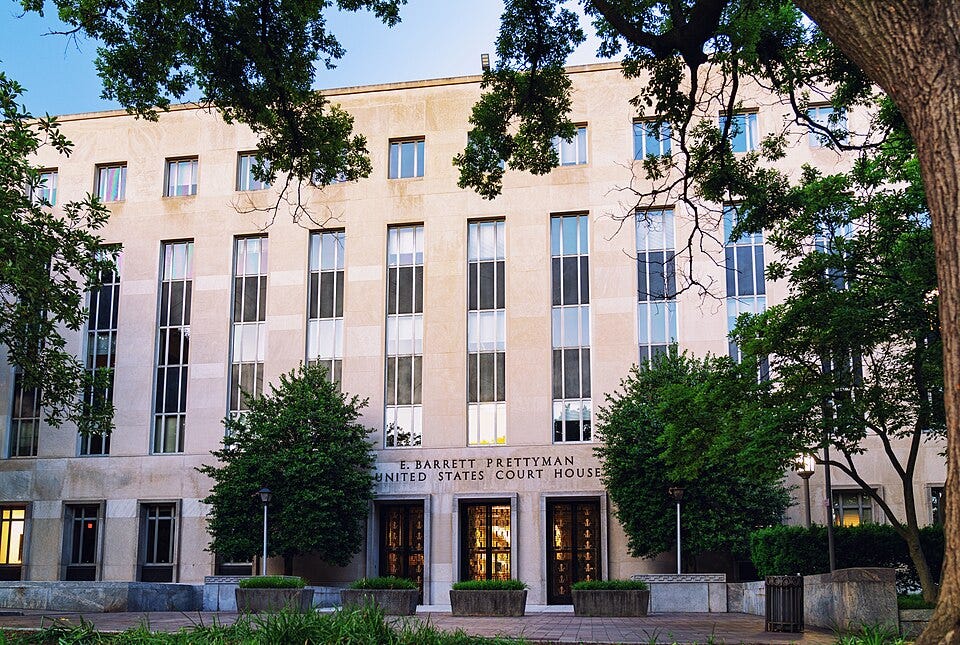
Late last night, Senior Judge Royce Lamberth, a Reagan appointee who serves on the DC District Court, issued an injunction blocking the Trump administration from moving trans women held in federal prisons to men’s facilities. The injunction, the seventh such injunction issued by Judge Lamberth in the case Doe v. McHenry, comes after the previous injunctions were lifted in mid-April by an appeals court panel—a panel composed primarily of Obama appointees—which found that the injunction needed to be decided on an individual basis.
At least for now, the ruling means the 14 plaintiffs in the case—a group that forms the majority of the trans women in federal women’s prisons—will remain in their current housing after Lamberth found every one of them would “suffer imminent and irreparable harm” if placed in a men’s facility. The Trump administration has once again appealed his ruling. But as Lamberth pointed out in his decision, this case has been complicated by a separate lawsuit in Northern Texas, where a group of cis women housed in the federal women’s prison FMC Carswell sued the Bureau of Prisons (BOP) over the Biden administration’s policies that allowed trans women to be housed in women’s prisons.
Last week, the court there blocked the Trump administration from housing trans women in cells with cis women and ordered FMC Carswell to use “separate movement, routing, scheduling, or other measures as necessary to prevent overlap between male inmates [which the ruling defines as ‘any inmate who is biologically male, regardless of gender identity’] and female inmates in housing and shared spaces.” As such, Lamberth states that his ruling does not require that the BOP violate the injunction, only that the four trans women in FMC Carswell not be transferred out of the facility.
Over the past 18 months, the federal government’s policies surrounding trans people in prisons have become a serious cause for concern. On his first day back in office, Trump signed Executive Order 14168, which, along with erasing trans people at the federal level, implemented a slew of restrictions on the trans people held in federal prisons. Immediately, those who were receiving gender-affirming care were stripped of their medications, and the BOP began preparing to move the handful of trans women in its custody to men’s prisons, sparking legal challenges. Coincidentally, both cases were randomly assigned to Lamberth, who has consistently ruled against the Trump administration when it comes to this issue.
Although these policies only directly impact federal prisons, they’ve reverberated across many states as well. In December, the Trump administration stopped enforcing the federal sexual violence protections for trans people in prisons that, up until that point, every state (except Alaska) has abided by since they were finalized in 2012. These repealed protections included provisions prohibiting states from categorically refusing to house a trans prisoner in a facility that aligns with their gender identity. At the same time, the Trump administration has launched investigations into California, Maine, and Washington over their more progressive policies.
However, in the past, courts across the county have found that placing trans women in men’s prisons is extremely harmful and that the resulting violence likely constitutes ‘deliberate indifference,’ which is considered cruel and unusual punishment and is prohibited under the Eighth Amendment. And now that Lamberth’s injunction has addressed the DC Circuit Court’s opinion, it remains to be seen if this standard will continue to be applied during the appeal. Even so, the Trump administration’s increased desire to win on this issue—which no other state has shown thus far—coupled with this fight’s nationalized scope almost certainly means that this case will eventually reach the Supreme Court. Because the court has never directly ruled on policies impacting trans prisoners, any ruling on the issue has the potential to transform the legal landscape that trans people face—for better or worse.
Thank you for reporting on issues affecting transgender prison inmates, Aleksandra! Before I left the country, my most horrifying recurring nightmare was that of being incarcerated in a men's prison for doing absolutely nothing wrong. It was one of my greatest fears and one of the important factors underlying my decision to leave.
Sexuality is a spectrum, not a given.
Every person born produces both male a d female hormones. How you develop isn't a choice.