

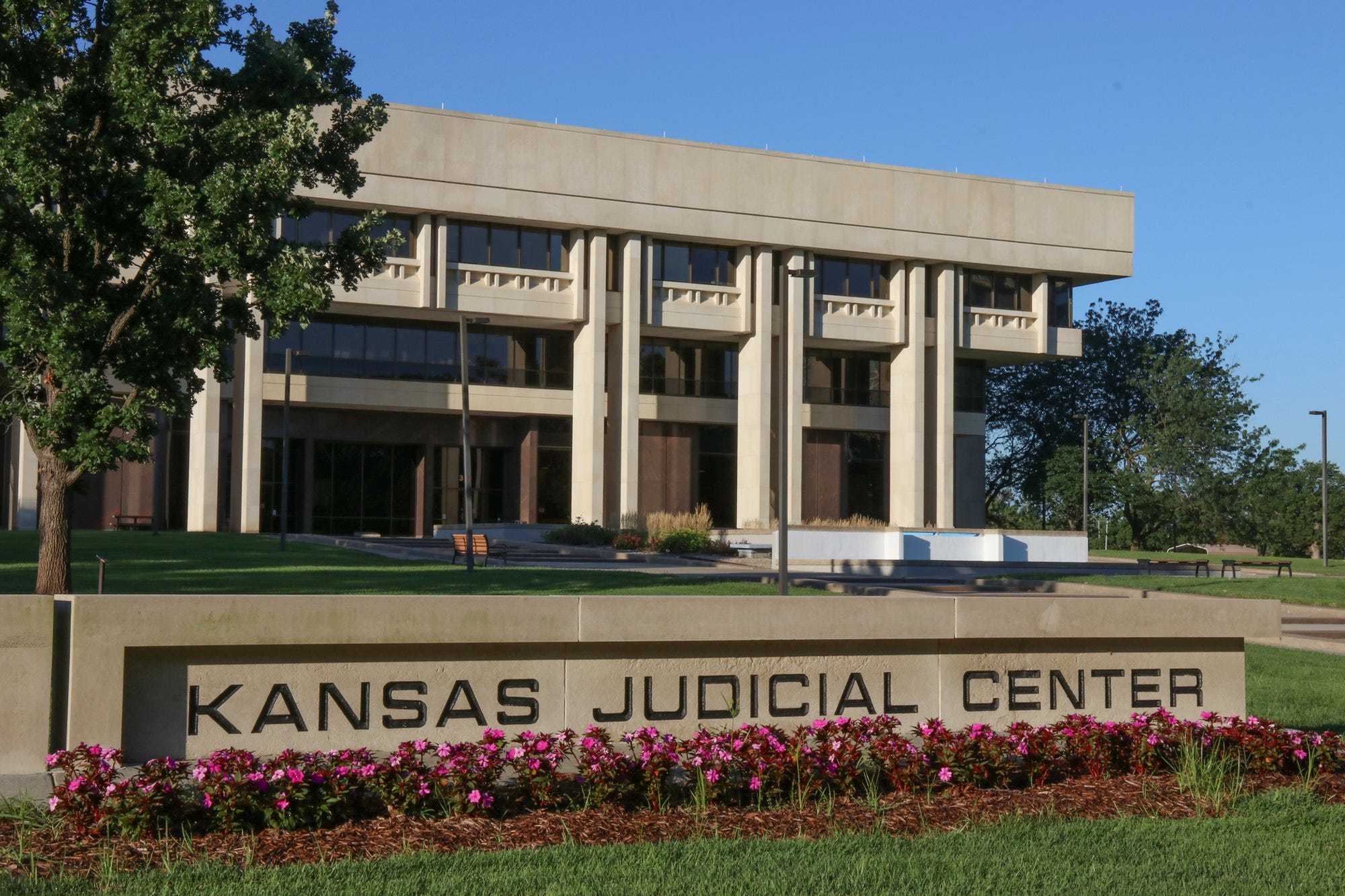
Moments ago, a Kansas district court declined to grant the ACLU’s request for a temporary restraining order that aimed to block the enforcement of Kansas’ extreme anti-trans law SB 244. The law, which passed on February 18th after Republicans overrode the Democratic governor’s veto, criminalizes transgender people’s bathroom use in public buildings, enacts the first ever bathroom bounty provisions, and revokes trans people’s IDs and birth certificates if they don’t display their sex assigned at birth. At least for now, this decision means that trans Kansans will continue to face the consequences of the most severe anti-trans law passed so far.
Even before SB 244 went into effect around two weeks ago, trans Kansans began receiving letters notifying them that their driver’s licenses would be invalidated the next day as “the legislature did not include a grace period” to allow trans people to update their licenses. This swift implementation, which was made possible because the state had internally flagged trans people’s document changes, has left many in Kansas without the ability to drive entirely, as driving without a valid license is considered a class B misdemeanor—punishable by up to 6 months in jail and a $1,000 fine. Even worse, Republicans did not make exceptions for those driving to the DMV to get a new license, meaning trans people would get punished for complying with the new ID restrictions.
Despite being faced with these facts, Judge James R. McCabria—who was appointed by Kansas’ last Republican governor Sam Brownback—determined that the court “simply does not have the information the law requires to enter Temporary Restraining Order at this stage of the proceedings.” As part of this reasoning, McCabria wrote in the decision that because the plaintiffs did not provide examples of them facing harassment over their bathroom use, the court cannot “exercise the tremendous power of an injunction” based purely on “speculation.”
The decision goes even further, stating that for the plaintiffs to be successful in their challenge, they may have to prove that “every restroom visit is fraught with the potential for violence or embarrassment”—a nearly impossible standard. And it cites, among other things, the US Supreme Court’s rulings against gender-affirming care and trans people’s passports, to say that the court cannot assume trans people are protected by the Kansas constitution.
For some background, the lawsuit, Doe v. State of Kansas, is being brought by the ACLU on behalf of two trans men—one a government employee and the other a PhD student at a public university. And here, the ACLU is attacking the law from all sides. First, the filing argues that the law violates procedural due process as it did not give trans people “sufficient notice and reasonable opportunity to comply” with both the driver’s license and bathroom provisions. Second, the ACLU asserts that because carrying an inaccurate ID or using a restroom that doesn’t correspond with their appearance forcibly outs trans people, SB 244 violates trans Kansans’ rights to personal autonomy, privacy, and free expression.
Third, the plaintiffs claim that the law imposes a sex-based classification that unfairly burdens trans people, running afoul of the Kansas Bill of Rights’ requirement that “similarly situated individuals should be treated alike.” Finally, the ACLU argues that SB 244 violates Kansas’ “single subject” rule, which prohibits the legislature from passing bills containing more than one subject with limited exceptions, by imposing restrictions on both documents and bathrooms.
Although McCabria can still agree to block the law later in the proceedings, today’s decision means that outcome is unlikely. Thus, transgender Kansans will be left to fight alone until the case can make it before the friendlier Appeals and state Supreme Court, which could take years.
You can read the full decision here.

What a bigoted decision!
Thank you for continuing to timely cover this story 🩷