

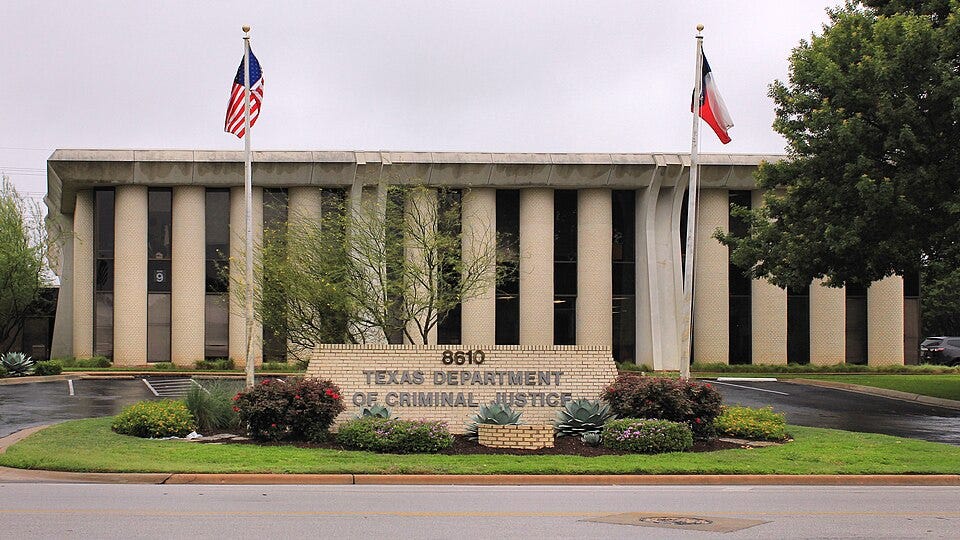

In August 2015, amid a shifting legal landscape for trans prisoners, the Texas Department of Criminal Justice (TDCJ) announced that it would begin allowing all trans people in its custody to access hormone therapy, a landmark decision that made the Lone Star State one of the first southern states to implement such a policy. Prior to the change, the TDCJ had enforced a so-called ‘freeze frame’ policy—a policy restricting hormone therapy access to those who’ve already begun transitioning prior to their incarceration—since 2006, and it often meant that many would be made to wait years until their release to get the care they needed.
Although the change garnered some negative attention from local media once it was reported the next February, the issue quickly faded from public consciousness, and the policy, G-51.11, remained. Perhaps most tellingly, it wasn’t even publicly opposed by the then newly elected Gov. Greg Abbott and AG Ken Paxton, both of whom would go on to define the state’s sharp anti-trans turn in the coming decade.
But it wasn’t without controversy. Two months before the policy was introduced, an incarcerated trans woman filed a lawsuit alleging that the state’s denial of gender-affirming surgery constituted cruel and unusual punishment under the 8th Amendment. After her suit was dismissed by a district court, she appealed the verdict to the notoriously conservative 5th Circuit. In a 2-1 ruling published on March 29th, 2019, the court denied her appeal, making a point to deadname and misgender the plaintiff while writing that “a state does not inflict cruel and unusual punishment by declining to provide sex reassignment surgery to a transgender inmate.”
The Supreme Court declined to hear her appeal that December, and for the next six years, the TDCJ’s policies surrounding trans people weren’t seriously challenged. Nevertheless, in August 2025, as part of the anti-trans bathroom bill Senate Bill 8, the state became the first in the nation to pass a law mandating that trans prisoners be housed in facilities “according to their biological sex.” Despite that law, however, Policy G-51.11 and its hormone therapy provisions remained; the policy was renewed in July 2026, and it seemed that, barring legislative action, the TDCJ would continue to maintain the status quo.
Then, out of nowhere, Policy G-51.11 vanished. As did the three related documents that were previously found within the TDCJ’s Correctional Managed Health Care (CMHC) Manual: a revision explanation from 2014 and two consent forms for hormone therapy, both of which were also updated this past July. The links to all four of these documents now return a 404 error, and perhaps most interestingly, the HTML code responsible for displaying them on the manual’s site is still present but has been deliberately commented out in its entirety.
And it wasn’t just those four documents. Eleven days ago, the TDCJ released its 2026 Disease Management Guidelines, making only one major change from its 2025 version: the section titled “Gender Dysphoria Hormone Monitoring Guideline” was removed, and in the document’s table of contents, the 34 subsequent entries were all renumbered accordingly. Meanwhile, the CMHC’s formulary—a formal listing of the medical drugs the TDCJ provides that mentioned the term “gender dysphoria” several times—has also disappeared from the CMHC’s publications list.
In a phone call with Transitics today, the Texas Department of Criminal Justice confirmed that Policy G-51.11 is no longer in effect and that it hasn’t been for ‘a few weeks.’ Transitics was also told that no policy is replacing it, effectively meaning that TDCJ health services are no longer authorized to provide gender-affirming care. TDCJ declined to provide any more details when asked.
As for why the state waited until now—a few weeks after the policy was renewed—to rescind it remains a mystery. That said, the execution isn’t exactly surprising. Two years ago, the state made headlines nationwide for implementing its ban on driver’s license gender marker changes virtually overnight, and just one week later, the state’s Department of Health and Human Services implemented the same ban for birth certificates. Both changes were made at the urging of AG Ken Paxton.
Given Paxton’s stance on gender-affirming care in prisons is similarly extreme, it’s entirely possible the quiet and sudden removal of G-51.11 was the result of similar maneuvers. However, regardless of the cause, the policy makes Texas the 6th state to entirely ban this care in its prisons. Bans in another two, Georgia and Idaho, are currently blocked by courts. Texas is the first to do so without having first passed legislation, and it is also the first to do so without any warning or announcement.
For sources, tables, and more maps, head to Transitics’ CATPALM page.
Even worse, Texas’ state prison system is by far the largest in the country, housing an estimated 149,000 people. The next largest, California and Florida, house 96,000 and 87,000 people, respectively. It must be noted that Florida also blocks its prisoners from accessing gender-affirming care; up until a few weeks ago, it was the largest state with such a policy.
However, the disparity between these states is even larger when it comes to trans inmates. In 2019, the total number of transgender people in TDCJ custody was estimated to be around 1,100. Meanwhile, in 2020, Florida’s total was found to be 235. Although exact totals are scarce, these numbers are estimated to have risen slightly in recent years. And in 2022, the total number of trans people incarcerated in US state prison systems was estimated to be roughly 5,000; in other words, Texas’ new ban on gender-affirming care in its prisons impacts more than 1 in 5 of all trans people in state prisons.
That statistic is simply horrific. It means that, as of today, over 1,100 trans people in Texas prisons will be forcibly detransitioned until they are released or until it breaks them. And by doing it quietly, the state hoped to get away with it without anyone noticing, at least for a short time.
Unfortunately, there isn’t much that can be done. Texas state courts are far from receptive to trans people’s struggles, and a case in the Fifth Circuit is even more of an uphill battle. Really, there are only two ways the state’s ban can be overturned: a) if the largely conservative US Supreme Court rules that states cannot deny this care and b) if the state’s anti-trans government chooses to show mercy. At least in the next few years, neither comes close to seeming plausible. In the meantime, Texas’ trans prisoners will be tortured, suffering more than they have in 20 years.
And it wasn’t to score political points. It wasn’t to ‘save taxpayer money’ either. In an election season, both of those motives would be touted. Suffering, inflicted without warning, truly appears to be the policy’s only discernible purpose.
That cruelty is the point.
In Texas, the cruelty is always the point, the cruelty and the fealty to big money interests.
Thank you for breaking such horrific news. I interviewed formerly incarcerated trans folks in college after in high school, I lost a transmasculine friend who was in juvie and mentally ill, not thoroughly observed nor treated, and housed with the girls. The conditions are horrific. I heard a lot of terrifying stories, and I could I think share my final paper on it with you if useful (I declined by sociology professor's ask to publish it, because I didn't think he cared for the people involved so much as the career points)