

See the full timeline at timeline.transiticsnews.com.
As recently as 2021, 48 states allowed transgender people to change their gender markers on their birth certificates. The preceding decade had been one of progress, with many blue states removing longstanding surgery requirements and recognizing non-binary identities for the first time. Fueled by those victories, advocates were looking to continue their push in Republican-controlled states, hopeful that they could extend those fundamental rights to all trans Americans.
But they’d never get the chance. As Republicans began taking aim at trans rights more broadly, restrictions on trans people’s birth certificates quickly followed. Oklahoma in 2021. Montana in 2022. Kansas in 2023. Florida and Texas in 2024. Indiana and Iowa in 2025.
This year, Idaho, South Dakota, and Wyoming have all implemented bans of their own. Along the way, lawsuits overturned bans in Montana and West Virginia. As things stand, trans people’s identities are now recognized in only 40 states.
At the center of this assault lies one idea: allowing trans people to update their documents is a fundamentally ‘woke’ idea that has only recently taken hold, and that by banning those changes, the ‘accuracy’ and ‘integrity’ of vital records can be preserved. Meanwhile, when fighting against these policies at legislative hearings and in court, advocates usually focus on how having accurate documents benefits trans people instead of refuting conservatives’ arguments.
Put differently, they articulate it as being a right that people should have and not as an established right that these efforts are taking away. As a result, the entire American system—legislatures, courts, and public opinion—hasn’t been given the opportunity to consider or examine the latter argument. But this begs an important question: could that argument even be made?
After all, for topics related to gay rights, like sodomy laws or the recognition of same-sex unions, an exact timeline is known starting with Illinois in 1962. Wikipedia itself features animated maps and a thorough timeline. Historians reference these laws with precision, and legal, medical, and advocacy organizations all regularly feature the same information. And perhaps most interestingly, these timelines have been established for decades: in 2003, the Supreme Court even went as far as using the history of these laws to justify striking them down.
Conversely, for legal gender changes, advocates, courts, and legislatures often have trouble establishing the history of that right just in their own state. Don’t believe me? Just try finding what the first state to grant that right was and when it was granted. According to the website Equaldex and this 1993 French-language report that was submitted to the Council of Europe (CoE) over 30 years ago, it was Illinois in 1962, but according to the California legislature’s analysis of a bill in 2011, it was California in 1977.
What about the second? The CoE report states that the second was Arizona in 1968, but Equaldex claims Arizona only legalized these changes in 2006—which would place it firmly after California. And the third? Again, according to the CoE report, it’s Louisiana in 1968, but the state’s own courts have claimed that the law in question was only passed in 1979. As such, basing a timeline on this conflicting information would probably result in something like this:
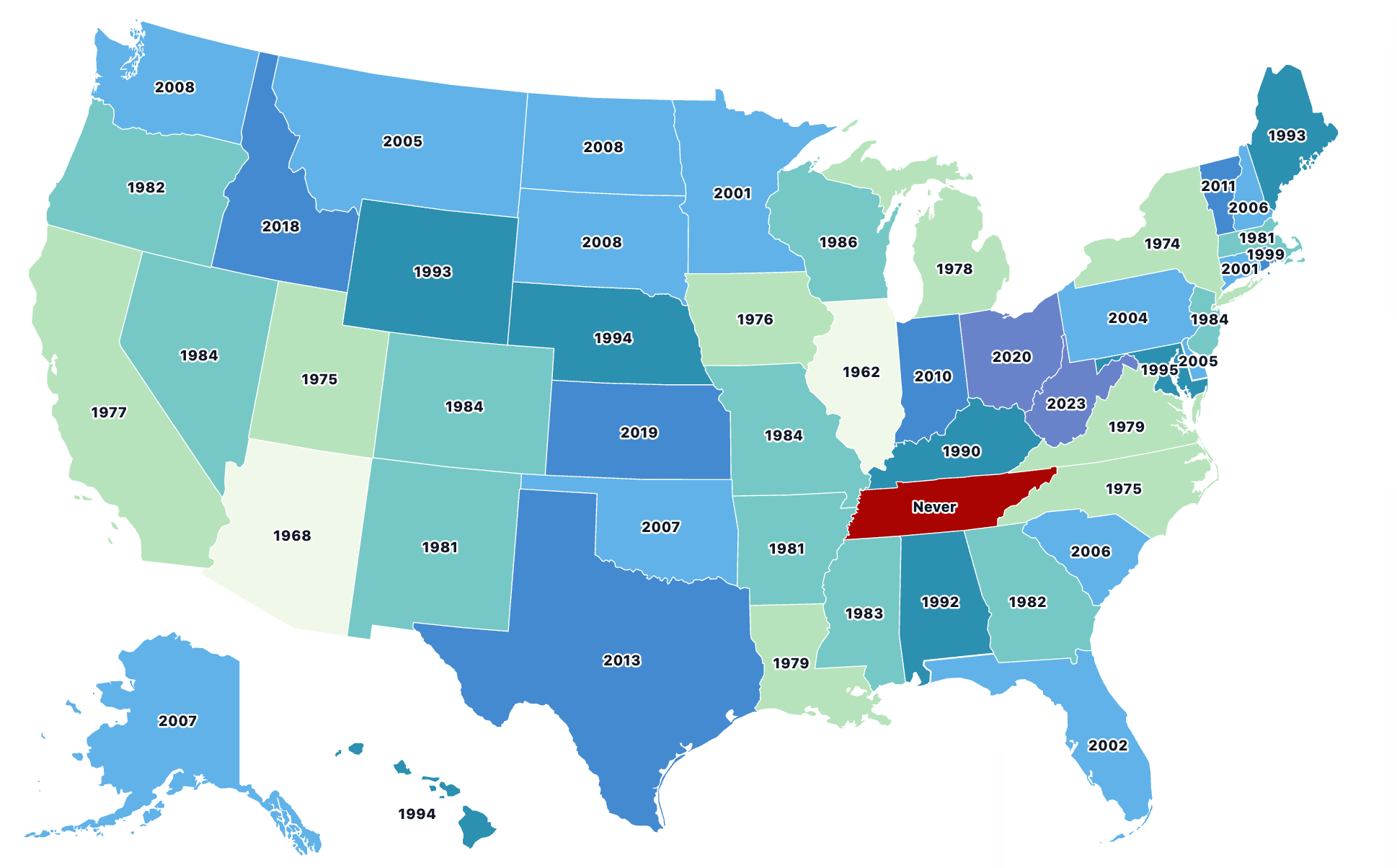
Given these glaring issues, it’s obvious why historical arguments are yet to be employed when it comes to this issue. Without a timeline, the arguments can’t be formulated, but at the same time, getting the timeline wrong can have catastrophic consequences for the lawsuits it hopes to bolster. And because birth certificate amendments aren’t always handled by statutes—unlike gay rights issues—histories for many states have been lost to time. As such, that history has remained forgotten.
Or at least it did.
Truth be told, this problem has been sitting in the back of my mind for quite a while. In April, hoping to establish a timeline of the assault on trans people’s documents, I added a column denoting the enactment date for those policies as part of a major update to my policy tracker. But because of the lack of consensus and timeline and having no clear way to display any potential findings, the idea ended there. However, a few weeks ago, a relatively dry spell of news presented an opportunity, and I began working on the project.
Now, nearly a month later, I’m proud to be unveiling—for the first time in history—a comprehensive timeline on the right to a legal gender change in the United States. I’ll be going over the core findings here, but to view the full data for each state as well as an interactive map, please visit timeline.transiticsnews.com or click the button below.
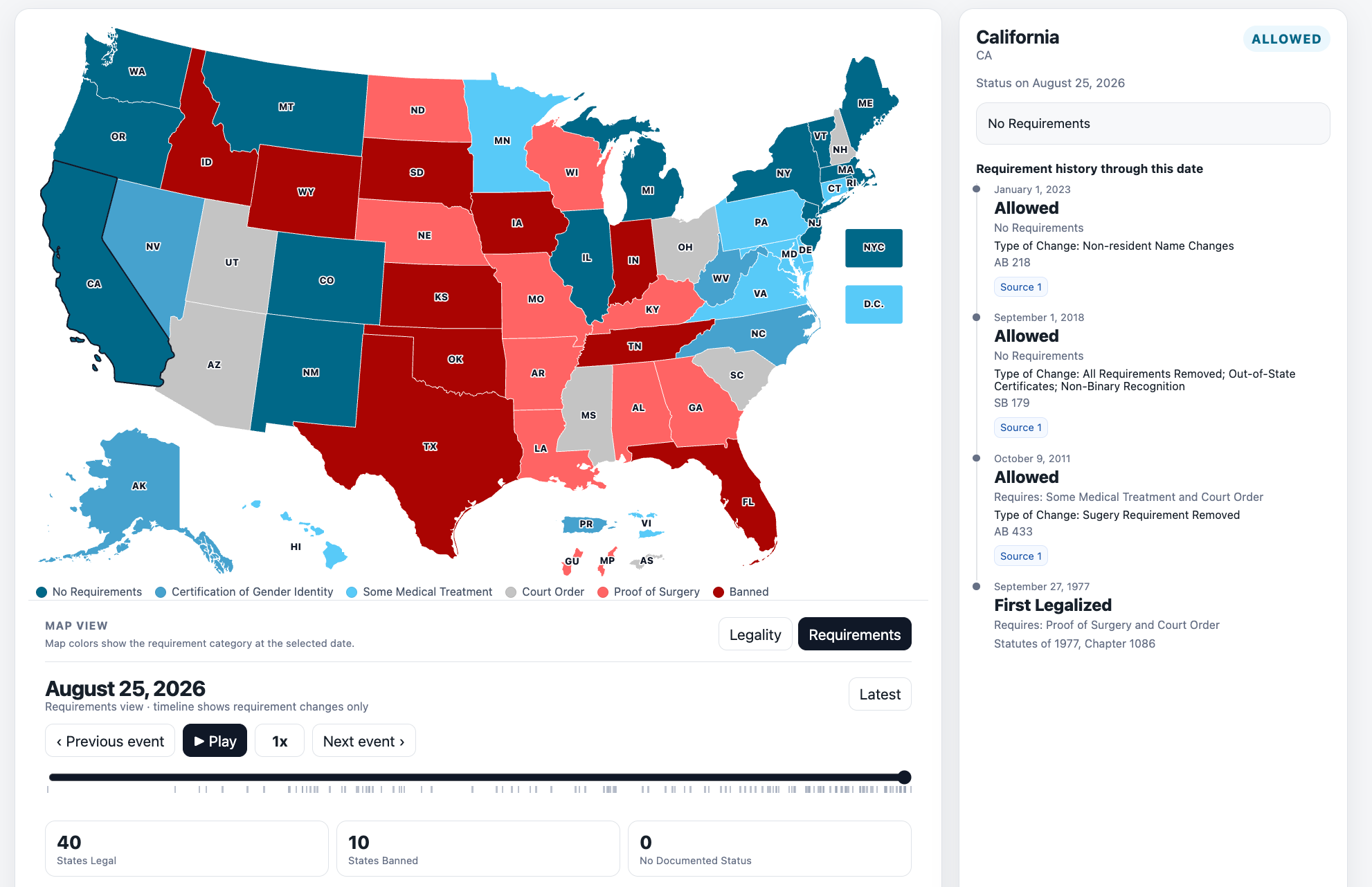
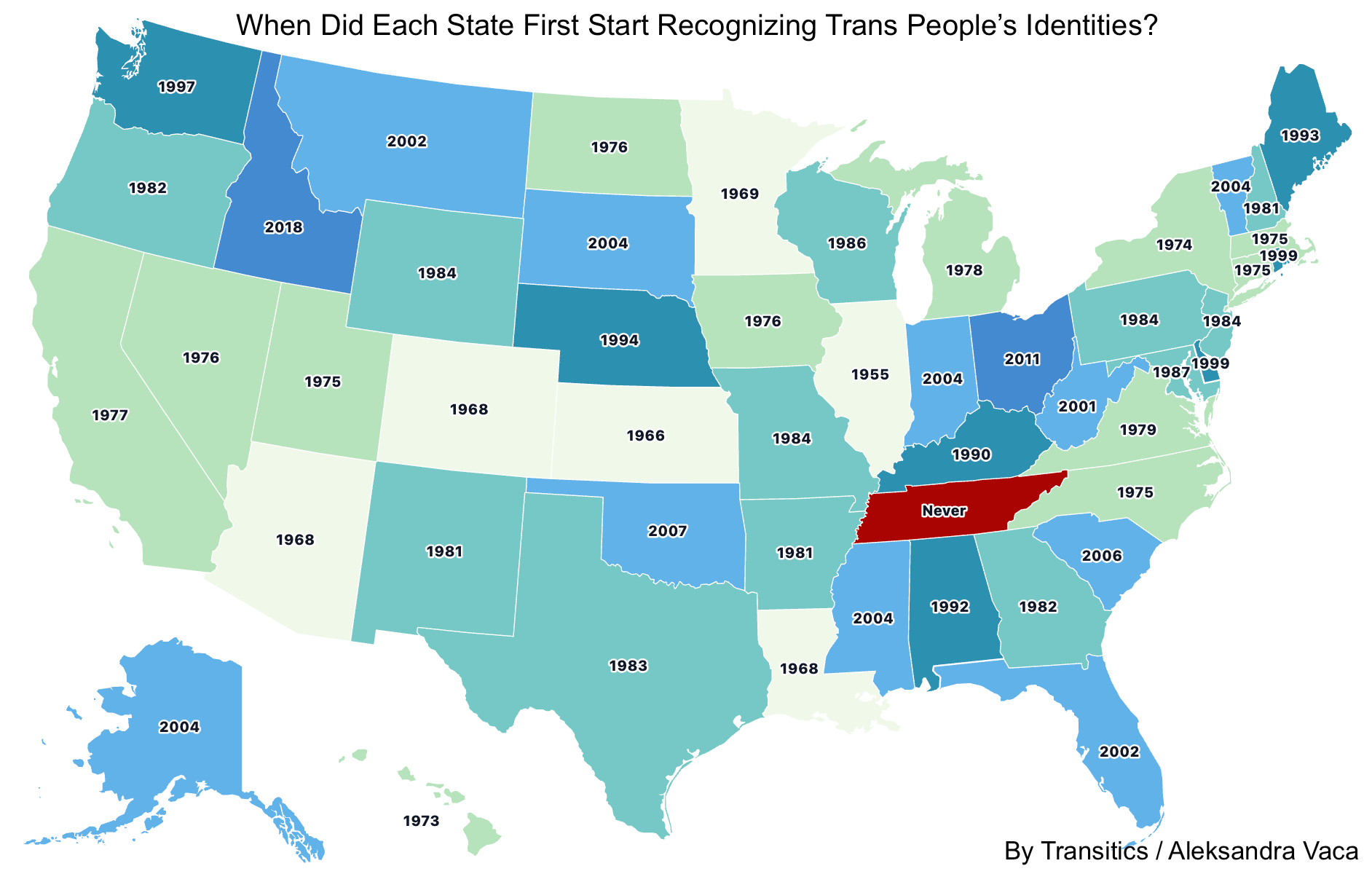
I’ll start by addressing the questions I asked above: the sources I mentioned were right about Illinois being the first, but the state passed its law in 1955—meaning that the right to a legal gender change has been around longer than Alaska and Hawaii have been states. It wouldn’t be another ten and a half years until a second state began allowing these changes, but notably, that state hasn’t ever been mentioned in any of these discussions, court cases, or legislative proceedings.
Because the second state was actually Kansas. That’s right: the same Kansas that recently revoked trans people’s documents was also the second state to legally recognize their existence. The provision in question, K.A.R. § 28-17-20, was enacted on January 1st, 1966, and allowed sex changes when substantiated by “a medical certificate when the change is physiological or anatomical.” But it gets even weirder, as Kansas also holds the distinction of being the second state to ban these changes after having already legalized them—in 2002, after Texas—the second state to legalize them two separate times—in 2019, again after Texas—and the second state to have banned them on two separate occasions—in 2023, after Ohio.
Meanwhile, California, despite claiming to have been first, was really the seventeenth. Aside from Illinois and Kansas, Arizona, Colorado, and Louisiana (1968), Minnesota (1969), New York City (1971), Hawaii (1973), New York State (1974), Utah, Massachusetts, North Carolina, and Connecticut (1975), and North Dakota, Iowa, and Nevada (1976) all enacted their laws, regulations, or policies prior to California. Interestingly, the first state to not include a strict surgery requirement was Utah, and Iowa’s law was the first—and until 2008, the only—to explicitly not require surgery. That law, 1976 House File 798, used the language “by reason of surgery or other treatment,” and an archived news article from 1983 that was reviewed as part of this project confirms that the law was interpreted as such since its passage.
By the end of 1984, trans people’s identities were recognized in 28 states—plus New York City, D.C., and Guam—a figure that’s actually higher than the number of states that permitted same-sex relations at the time, which was 26. In fact, this statement would remain true until the Supreme Court struck down sodomy laws nationwide in 2003; at that point, 38 states were recognizing legal gender changes while only 4 explicitly banned them. This history matters. Here’s a full map:
Taking a peek at the legislative records of many of those early laws, which, except for Arizona’s, pretty much exclusively addressed trans people’s birth certificates, this information becomes damning. Illinois’ 1955 law passed 107-2 in the state House and unanimously in the Senate. Arizona’s 1968 law passed unanimously in the House and 28-1 in the Senate. Louisiana’s 1968 law passed 87-8 in the House and unanimously in the Senate and was introduced on the request of a trans woman who wanted her birth certificate changed.
In the 1970s, it was a similar story. Hawaii’s 1973 law passed unanimously in both chambers and was enacted alongside a repeal of the state’s crossdressing ban. The 1975 laws in Utah and North Carolina passed unanimously in both states. Iowa’s 1976 law passed 65-12 in the House and unanimously in the Senate and was introduced specifically to reverse a 1974 attorney general opinion asserting that the state had no authority to amend birth certificates for trans people. Extraordinarily, out of all these states, the idea of legal gender recognition was at its most controversial in California, where it passed 41-30 in the Assembly and 21-3 in the Senate. In fact, only one trans-specific bill in this period—1980 Ohio House Bill 750—failed to become law, passing the House 52-43 before dying in the Senate without receiving a vote.
Nowadays, this story is changing. While Illinois, Hawaii, and California have become much more protective of trans people, many of the others mentioned are taking aim at the very right they overwhelmingly granted. In 2025, Iowa entirely repealed the provision that allowed trans people to update their birth certificates as part of a targeted effort to erase trans people from its legal code. This law, Senate File 418, also notably removed the gender identity discrimination protections that had been in place since 2007. A few months later, North Carolina passed a law mandating that trans people’s birth certificates are issued as “multi-page documents” instead of being new certificates designed not to out them.
This year, Wyoming also banned gender changes through its administrative rules in March, and unlike the other states mentioned, that ban is now before the state’s Supreme Court (which had previously unanimously ruled in favor of trans people’s amendments in 2020). As part of that case, the state’s Attorney General has claimed that the rule’s sex change provision originated in 1993; in reality, documents obtained by Transitics as part of this project have now revealed it was actually added in 1984 as part of the state’s first and only major overhaul to its birth certificate amendment rules. Finally, in Utah, a ban on legal gender changes passed the state House before ultimately failing in the Senate.
Through these efforts, Republicans aren’t just hoping to erase trans people’s rights; they’re hoping to erase trans people’s history. And for far too long, we’ve not only let them—we’ve actually helped them.
As part of this project, I reviewed a slew of recent and historical bills, laws, and court cases that have impacted trans people’s birth certificates, as well as the discussions, legal analysis, and legislative testimony surrounding them. Throughout all of these documents, the one thing that has almost never been mentioned—by either side—is history. When it is mentioned, like it notably was in California in 2011, the cited figures are often comically inaccurate. Instead, advocates tend to argue that legal gender recognition has always been an inherent right and that withholding it is wrong. But to more skeptical audiences and courts, this approach clearly hasn’t been enough.
Now, its historicity and background having never been properly asserted, our deeply rooted right is slowly being lost. As a result, today, the total number of states that provide legal gender recognition is the lowest it’s been since 2003.
And to move forward, we may very well just have to look to the past.
See the full timeline at timeline.transiticsnews.com.
Wow! This is an amazing tool. Thank you for your work on this!
This is incredible! Did you ever consider going open source with this? Could definitely make the gathering of information for such a large project much easier.