

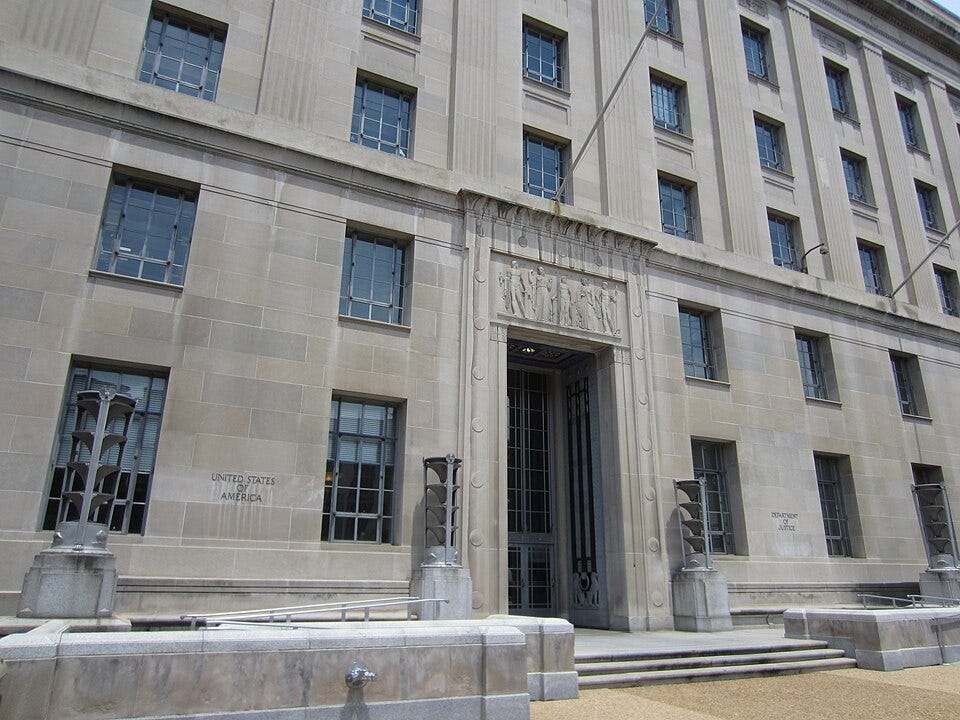

Last summer, the Department of Justice announced that it had sent at least 20 subpoenas to providers of care for trans youth. And these subpoenas, which were sent out as part of the Trump administration’s investigations into ‘healthcare fraud’ and ‘false statements’ surrounding gender-affirming care for minors required under EO 14187, were detailed. According to court filings, the DOJ’s request included demands that care centers turn over:
“Documents sufficient to identify each patient (by name, date of birth, social security number, address, and parent/guardian information) who was prescribed puberty blockers or hormone therapy.”
“Documents relating to the clinical indications, diagnoses, or assessment that formed the basis for prescribing puberty blockers or hormone therapy…for each such patient identified [as having received gender-affirming care].”
And “all documents relating to informed consent, patient intake, and parent or guardian authorization for minor patients identified [as having received gender-affirming care].”
It must be noted that the information being sought is considered individually identifiable health information under HIPAA privacy standards and can only be disclosed if required by law. It must also be mentioned that in this particular instance, the inclusion of a patient’s name, date of birth, social security number, and address indicates that, unlike other government requests, the risk of patients being reidentified is virtually guaranteed.
Of course, given this risk, at least 7 providers—including the Children’s Hospital of Philadelphia (CHOP) and the Boston Children’s Hospital—challenged these subpoenas in court and won favorable rulings. Meanwhile, others—including Rhode Island Hospital (RIH)—instead opted to negotiate with the Trump administration in a bid to get the identifying requests removed.
At least for RIH, these negotiations stretched through April, and on the 28th, the federal government asked RIH for a “conference this week regarding status”; as part of this, RIH proposed times the following day but received no response. Instead, on the 30th, the DOJ filed an enforcement motion almost 2,000 miles away in the Northern District of Texas, a preferred conservative venue.
And it paid off: in a highly unusual move, the district’s only judge—Bush appointee Reed O’Connor—granted the motion on the same day without allowing RIH to respond. The judge has since denied RIH’s request for a stay. 4 days later, the state’s government stepped in and filed a separate case seeking to quash the subpoena, this time in Rhode Island. The judge overseeing that case, Trump appointee Mary S. McElroy, is expected to rule on that motion prior to RIH’s May 14th compliance deadline.
Even just a week ago, most believed that these proceedings would serve as a test case for broader enforcement of the DOJ subpoenas; after all, RIH was the only target of these aggressive proceedings. But that couldn’t have been further from the truth. Last night, it was revealed that NYU Langone (NYULH) had received a grand jury subpoena—again from the Northern District of Texas. Unlike the administrative subpoenas sent to RIH or CHOP, a grand jury subpoena is issued as part of a criminal investigation and likely indicates that the federal government intends to bring charges against providers of gender-affirming care.
According to the information shared by NYULH, the federal government is demanding “information pertaining to patients under the age of 18 who received gender affirming care at NYULH between 2020–2026, as well as the names of NYULH providers and others who were involved in offering such care at NYULH in that timeframe.” Worse, NYULH shared that it was only “one of several institutions that received a grand jury subpoena from the U.S. Attorney’s Office in the Northern District of Texas.” However, the other recipients of these subpoenas are yet to be identified.
Make no mistake: the information being requested can rather easily be used to make a list of trans kids, their families, and their medical histories. Even if the DOJ were investigating healthcare fraud for the sake of investigating healthcare fraud here—and it can be safe to assume that this is not the case given EO 14187’s political nature—it still faces a significant burden in enumerating why it needs the names, dates of birth, social security numbers, and addresses of trans kids who bear no criminal responsibility in these proceedings under any standard.
Of course, in an April 30th declaration by Lisa K. Hsiao, the acting director of the DOJ’s Enforcement and Affirmative Litigation Branch, the government attempts to claim otherwise:
“The final group of requests [the identifying information requests mentioned above] will permit the United States to evaluate the scope of prescribing the drugs described herein (including the number and age range of patients treated), and consistency of diagnoses… Linking each patient’s clinical record to corresponding billing and insurance claims can demonstrate whether diagnoses were miscoded, which can prove fraudulent intent. Documentation of clinical justification, informed consent, and disclosure of off-label use is key to assessing whether the clinic (and/or potential co-conspirators) concealed or downplayed risks associated with using these drugs in a manner not approved by the FDA. Absence or minimization of such warnings could establish the intent to mislead. Patient charts also typically capture adverse outcomes, side effects, and complications of drug use. By reviewing multiple patient records, the investigative team may reveal systemic use of the same masking codes, fraudulent informed consent documents, etc.
“Finally, providing patient records can provide essential investigative leads. Parents may be witnesses about what disclosures were made. Patients (depending on age and circumstances) may provide information about the informed consent process, side effects, or other false or misleading information about the drugs conveyed during treatment. Health benefit programs tied to identified patients could provide additional information, including claim records, creating a triangulated evidentiary record.”
At least for the first section of this justification, it quickly becomes clear that this amount of identifying information isn’t needed. In fact, all of the goals—minus those requiring ‘documentation of informed consent’—in this section can be achieved using the information that Tennessee will gather under its new gender-affirming care data collection and publishing law. That law collects age, sex, mental health diagnoses, drug information, and provider information but will not collect names, dates of birth, social security numbers, and addresses. Meanwhile, information on informed consent can also be acquired without identifying patients.
The second section isn’t as straightforward. It’s true that parents and patients could serve as witnesses, but the government also clearly indicates that, even if it gets all this data, it will only seek information from some of them. And notably, a similar outcome would be achieved if the DOJ only collected a patient’s parental information and address, as, in virtually every instance, the investigators would be able to get in contact with kids through their parents or legal guardians. In other words, the DOJ wants this information—most of which it admits that it will not need—just in case it might need it later. Worse, it never states that unused data will be deleted.
And there is a much less invasive way: the federal government and hospital could assign unique identifiers to each patient’s records, and, if the investigators want to contact them, the hospital could pass patient information along on an individual basis. Better yet, the hospital could first ask patients if they want to serve as witnesses and pass on their information if they agree.
So why not do this instead? And why not store parents’ information instead of collecting such specific information on kids? We might not ever know.
But here’s what we do know: we know that four states—Indiana, Kansas, Tennessee, and Texas—have made or are actively making lists of trans people using three different methods. Indiana and Kansas internally flagged gender changes to identity documents; Tennessee is collecting patient data; and Texas has been tracking those who ask about changing their gender on their driver’s license.
We also know that no state has been this aggressive in pursuing the identifying information of trans people and especially not of trans kids. And we know that no state wields as much power over a person’s identity as does the federal government.
If the Trump administration is allowed to acquire trans kids’ data, it will keep it even if providers defeat the federal efforts to intimidate them out of providing gender-affirming care to trans youth. That data includes their names, their addresses, their dates of birth, their social security numbers, and their parents’ information; in effect, this is a comprehensive entry of every trans person in the country that sought gender-affirming care as a minor over the past 6 years.
If that isn’t a government list, what is?
The Department of Justice issued at least 20 subpoenas to healthcare providers serving transgender youth. This is a move that should be understood as what it is: the construction of a government list. History offers no reassuring precedents here. From Reconstruction to the Red Scare, registries and surveillance systems have been deployed to isolate targeted minorities, strip them of legal standing, and prepare the ground for what comes next. The threat is not only the intent of those who build the list. It is the uses to which every future administration may put it.
I wonder if cis people will ever get their heads out of their asses and realize that when we say “genocide” we are NOT being hyperbolic. And if they come for one they will come for all. What is their obsession with trans people!?!