


Immediately upon entering office for a second time in January 2025, Trump shocked the nation’s trans community with his announcement that trans Americans would no longer be able to obtain passports reflecting their identities. “The Secretary of State,” Trump’s order—Executive Order 14168—reads, “shall implement changes to require that government-issued identification documents, including passports [and] visas, accurately reflect the holder’s sex,” where sex is defined as “an individual’s immutable biological classification as either male or female.”
Within a few weeks, the ACLU filed a challenge against the ban, and that June, Massachusetts District Judge Julia Kobick—a Biden appointee—issued a nationwide injunction blocking it. After a couple weeks of delays, the State Department complied and once again began issuing accurate passports to trans people. However, it wouldn’t last: on November 6th, 2025, the Supreme Court stayed the injunction via shadow docket ruling, clearing the way for the Trump administration to enforce the policy in its entirety.
As Transitics reported last November, the State Department’s implementation of the ban is extremely airtight. Even back then, there were several known cases where first-time trans and even cis applicants reported being asked to submit extra documentation that established their ‘sex at birth’ and/or had their gender markers changed against their will. All details relating to this process, which the State Department termed ‘adjudication,’ were kept entirely confidential even as the litigation played out.
But now, after nearly 20 months of secrecy, the State Department has finally declassified its full guidelines for ‘adjudicating’ sex markers on passports, and unfortunately, it’s even worse than was previously believed. The policy in question, which is codified as Section 403.3 of Volume 8 of the Foreign Affairs Manual and is simply titled ‘Sex Markers,’ is divided into four subsections: Summary, Procedures, Eligibility for a Fully Valid Passport or Passport Card, and Indicators of a Prior Change to Sex Marker.
Although the first subsection is fairly barebones and only serves to remind employees of Trump’s executive order, the same cannot be said about the second. That section, ‘Procedures’ (8 FAM 403.3-2), opens with a statement informing employees that “most applicants have a consistent sex marker on all their documents and applications” and that they “do not need to do extra research to confirm an applicant’s sex marker unless there is an indicator he or she previously changed his or her sex marker.” What counts as an ‘indicator’ is found in the 4th subsection, which we’ll get to soon.
After directing employees to “establish [a person’s sex] by the preponderance of the evidence” if an applicant requests to either change their gender marker or to be issued an ‘X’ marker, the manual further instructs passport workers to “review conflicting information and relevant Department databases to best determine which document accurately reflects the applicant’s biological sex at birth.” It should be noted that the ‘Department database’ in question is the American Citizen Records Query (ACRQ), which is an internal database containing an electronic record of a person’s past passport applications as well as copies of all the supporting evidence that the person has ever submitted to the State Department.
As part of this lengthy process, if a person’s sex cannot be properly adjudicated, employees are told to “suspend the application with information request letter (IRL) 708-21.” According to a copy of IRL 708-21 that was posted online last year, if this happens, the State Department will require that a person submit “early public records that show [their] name and sex at the time of your birth,” which includes “medical records, hospital records, religious records, early school records, and/or any other public documents created at or near the date and place of [their] birth.” Applicants that fail to submit this information—information that not everyone has access to—may see their applications denied.

Lastly, in cases where an applicant either “does not select a male or female sex marker” or “cannot submit documents showing a binary biological sex at birth,” or if “there are no database records showing the applicant’s binary biological sex at birth,” the application will be referred to AskPPTAdjudication@state.gov, which is an email address belonging to the State Department’s Office of Adjudications. It must be noted that this office existed well before the current anti-trans policy was implemented and receives requests from a variety of topics.
The third subsection, known as “Eligibility for a Fully Valid Passport or Passport Card” (8 FAM 403.3-3), is fairly short, and aside from barring employees from circumventing the policy by issuing limited validity passports, it only does one other thing: needlessly prohibit trans people from obtaining a second passport book. Under State Department guidelines, a person is issued a second passport book under a few limited circumstances, including when their passport is being held at a foreign consulate and will not be ready in time for their trip. According to the new policy, however, trans people will be denied this right just because they’re trans, with the policy clearly stipulating that “if the primary passport has an incorrect sex marker, it must be corrected prior to issuing a second valid passport.”
Finally, there’s the fourth subsection: “Indicators of a Prior Change to Sex Marker” (8 FAM 403.3-4). As the policy explains, “conflicting sex markers on documents submitted by the applicant and/or previous passport records can demonstrate a previous change to his or her sex marker.” But even if those are absent, it also notes that “other applications may show that an applicant is requesting a sex marker that differs from his or her biological sex marker at birth.” Keeping with this, the State Department proceeds to list its ‘indicators’ of a ‘prior sex change’:
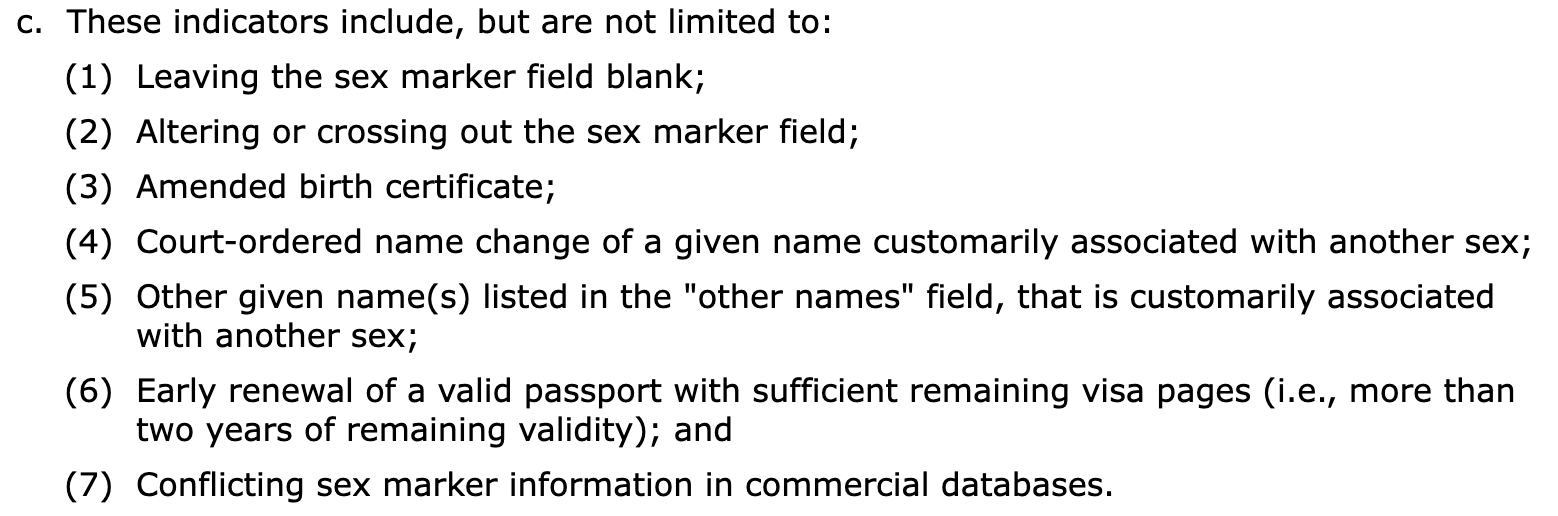
While some of those are typically associated with trans people, half of them actually aren’t. Of course, it’s possible for anyone to mistakenly “leave the sex marker field blank,” and although the other sections are meant to weed out trans people’s legal changes, cis people are equally scrutinized too. Furthermore, there are several reasons that a person would have an amended birth certificate that are not related to a gender change, including name changes, clerical errors, other information changes, and certain kinds of adoptions.
Lastly and perhaps most glaringly is (6). Needless to say, under the current administration, trans people really aren’t eager to renew their passports early; rather, it’s usually married women who are forced to apply for a passport early after changing their last names. Under the wording of this provision, they’d be flagged too. Thus, it can be said that the State Department is effectively including getting married in its list of “indicators of a prior sex change,” which is beyond absurd.
As if that wasn’t concerning enough, if a person checks any of those seven boxes, employees have been ordered to conduct thorough checks for a person’s legal history through various third-party commercial databases. This includes LexisNexis (which often returns their legal history (including information on court processes for a potential name change), home address, business/employment information, and full property portfolio), Nlets (which can pull up a person’s vehicle registration and DMV records, Social Security information, concealed carry permits, and criminal records), and EVVE (which contains information on birth certificates; although it should be noted that if a state issues a new certificate to a trans person—and 29 of the 40 that allow gender changes usually do—this search will be useless).
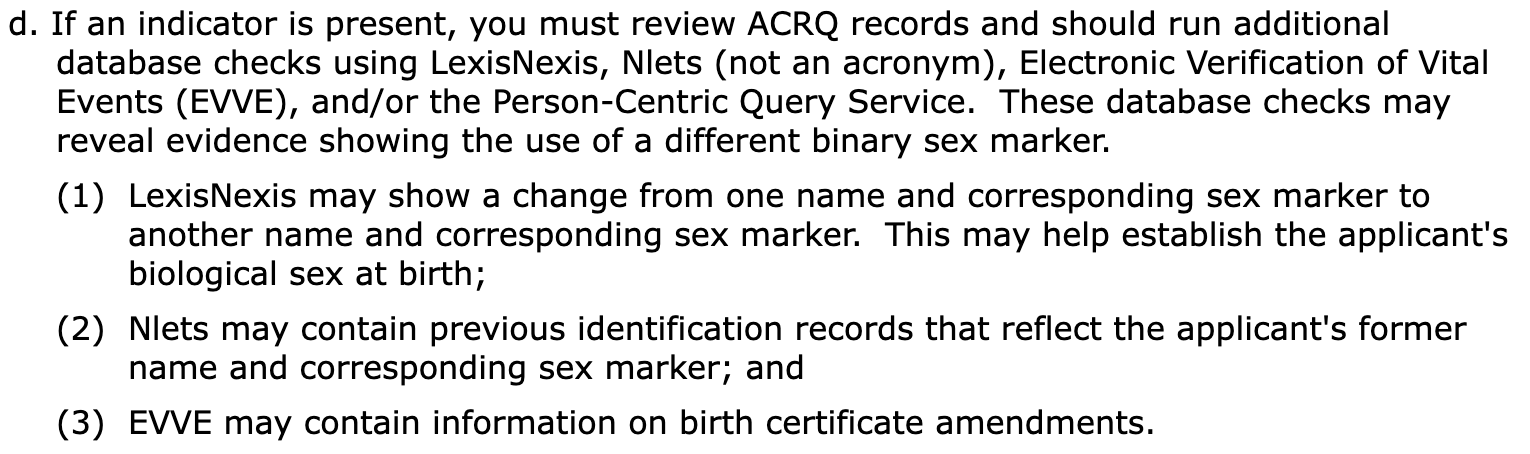
Finally, should these “database checks show the use of a different binary sex marker,” employees are directed to once again go through the adjudication process outlined in subsection 2.
8 FAM 403.3’s convoluted gender marker adjudication process is as dangerous as it is ridiculous. Under its extreme requirements, all Americans, both trans and cis, are being needlessly policed and scrutinized when applying for the very documents that are required to exercise the basic human right to travel. That scrutiny serves no legitimate purpose, as gender markers have absolutely no bearing on national security. And given that Trump ran in part on promising to cut back on “wasteful government spending,” it’s particularly hypocritical that government resources are now being put towards the extra labor it takes to adjudicate thousands upon thousands of applications.
However, thanks to its release, the policy’s enforcement is no longer shrouded in mystery. For the first time, trans people and our allies know exactly what we’re up against and exactly who else is being surveilled as part of the policy. For the first time, we know exactly why the Trump administration is being able to find out who’s trans and who isn’t. For the first time, we know exactly how our constitutional right to Due Process is likely being violated by the policy. And when arguing against it, we finally know where to start.
At the end of the day, the lengths the State Department will go to in 'adjudicating’ sex markers show just how much the policy’s sole purpose is to guarantee that no trans Americans slip through the cracks. Indeed, a ban that does not revert changes that have already been made would’ve accomplished the same rhetorical result; in many states, similar actions already have. But through this system, Trump ensures that all trans Americans are suffering equally under the policy.
To them, that’s all that matters.
This is exactly why I got a passport shortly before the 2024 election because I knew that if he won, he'd pull something like this.
Thank you so much for this news. I just cross-posted on my publications. A taxpayer-funded witch-hunt; absolutely ridiculous.